
How East Bay Private Schools Are Integrating AI Into Curriculum
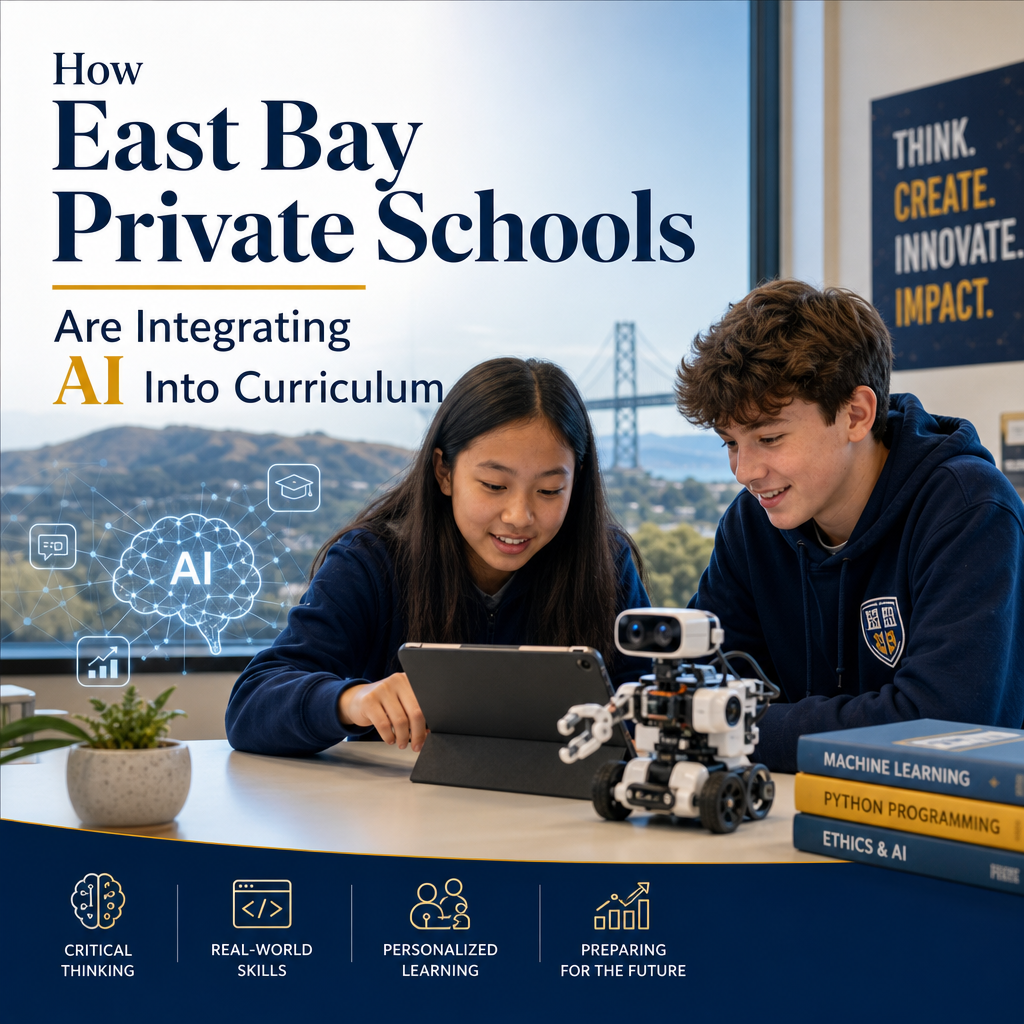
How East Bay Private Schools Are Integrating AI Into Their Curriculum
Artificial intelligence is no longer just a topic for college computer science labs. Across the Bay Area, schools are finding practical ways to bring AI into everyday learning, and East Bay private schools are increasingly leading that shift.
From coding projects to writing support and data analysis, AI is becoming part of how students learn, create, and think critically. But the goal is not simply to put new technology in the classroom. It is to help students understand how AI works, how to use it responsibly, and how it may shape their future.
Why AI Education Is Growing in Importance
AI now touches nearly every industry, including healthcare, finance, engineering, media, and education. Families want schools to prepare students for that reality.
Many East Bay private schools are responding by introducing AI in age-appropriate ways. Younger students may explore patterns, logic, and basic machine learning concepts. Older students are more likely to work with AI tools directly, discuss ethics, and examine real-world applications.
This approach helps students build more than technical skills. It also encourages:
- Problem-solving
- Digital literacy
- Critical thinking
- Creativity
- Ethical decision-making
In other words, AI education is becoming part of a broader effort to prepare students for a fast-changing world.
How AI Is Showing Up in the Classroom
AI integration looks different from school to school. Some programs are deeply technical, while others use AI as a tool to support existing subjects.
Computer Science and STEM Courses
The most obvious entry point is through STEM education. Students may learn:
- The basics of algorithms
- How machine learning models recognize patterns
- How data sets influence AI outputs
- The difference between automation and intelligence
In some East Bay private schools, robotics and coding programs now include AI-based challenges. Students might train a simple image recognition model, build a chatbot, or explore how self-driving systems make decisions.
These experiences make abstract ideas more concrete and give students hands-on practice.
Writing, Research, and Humanities
AI is also making its way into English, history, and social studies classes. Teachers may use AI tools to help students brainstorm ideas, analyze themes, or compare sources.
At the same time, students are being taught an important lesson: AI is not a replacement for original thought.
Instead, educators are using it as an opportunity to teach students how to:
- Evaluate accuracy
- Identify bias
- Verify information with trusted sources
- Use technology without losing their own voice
This balance is especially important in humanities courses, where discussion, interpretation, and perspective matter.
Personalized Learning Support
Some schools are using AI-driven platforms to provide more personalized instruction. These tools can help identify where a student is struggling and adapt practice material accordingly.
For example, a math platform might offer extra support on a concept a student has not mastered yet. A reading program could adjust difficulty levels based on performance.
When used thoughtfully, this kind of support can help teachers differentiate instruction without replacing human guidance.
Teaching Students to Use AI Responsibly
One of the biggest differences in strong AI programs is that they do not focus only on tools. They also focus on ethics.
Many East Bay private schools are pairing AI instruction with conversations about responsibility, including:
Academic Integrity
Students are learning where AI can be helpful and where its use crosses a line. Schools are updating policies around plagiarism, authorship, and proper attribution.
This helps students understand that convenience should not come at the expense of honesty.
Bias and Fairness
AI systems are only as good as the data they are trained on. That makes bias a major topic in AI education.
Teachers are encouraging students to ask questions such as:
- Who built this system?
- What data was used?
- Who might be left out?
- What could go wrong?
These discussions help students become more thoughtful technology users and future innovators.
Privacy and Safety
Schools are also addressing data privacy, especially when students use online platforms. Understanding how personal information is collected and protected is becoming an essential part of digital citizenship.
How Teachers Are Adapting
Successful AI integration depends heavily on faculty support. Many schools are investing in teacher training so educators feel confident using AI tools and guiding student discussions.
Professional development often includes:
- Learning how AI tools work
- Designing meaningful classroom uses
- Setting boundaries for student use
- Creating assignments that prioritize critical thinking
Rather than treating AI as a separate topic, many teachers are weaving it into existing lessons in practical ways.
Benefits and Challenges Ahead
There are clear advantages to bringing AI into schools. Students gain exposure to emerging technology, build future-ready skills, and learn how to navigate a world where AI will be common.
Still, there are challenges.
Schools must think carefully about equity, screen time, teacher training, and the risk of overreliance on automated tools. They also need to ensure that AI supports learning rather than narrowing it.
The strongest programs tend to share one key principle: technology should enhance education, not define it.
A Forward-Looking Approach to Learning
As AI continues to evolve, East Bay private schools are showing how education can keep pace without losing sight of core academic values. Their approach is not just about innovation for its own sake. It is about preparing students to think deeply, act responsibly, and adapt confidently.
By combining technical instruction with ethics, creativity, and human judgment, these schools are helping students do more than use AI. They are helping them understand it.
And in the years ahead, that may be one of the most valuable lessons a school can offer.