
How Hands-On AI Projects Help Students Learn Faster
Why Hands-On AI Projects Help Students Learn Faster
Students learn best when they move beyond theory and start building. That is especially true in artificial intelligence, where abstract ideas can feel confusing until they are applied to a real problem. Hands-on AI projects give students a chance to experiment, make mistakes, and see how concepts work in practice.
Instead of memorizing definitions or copying notes, students engage directly with data, models, and outcomes. This active learning process often leads to faster understanding and stronger long-term retention.
The Gap Between Knowing and Doing
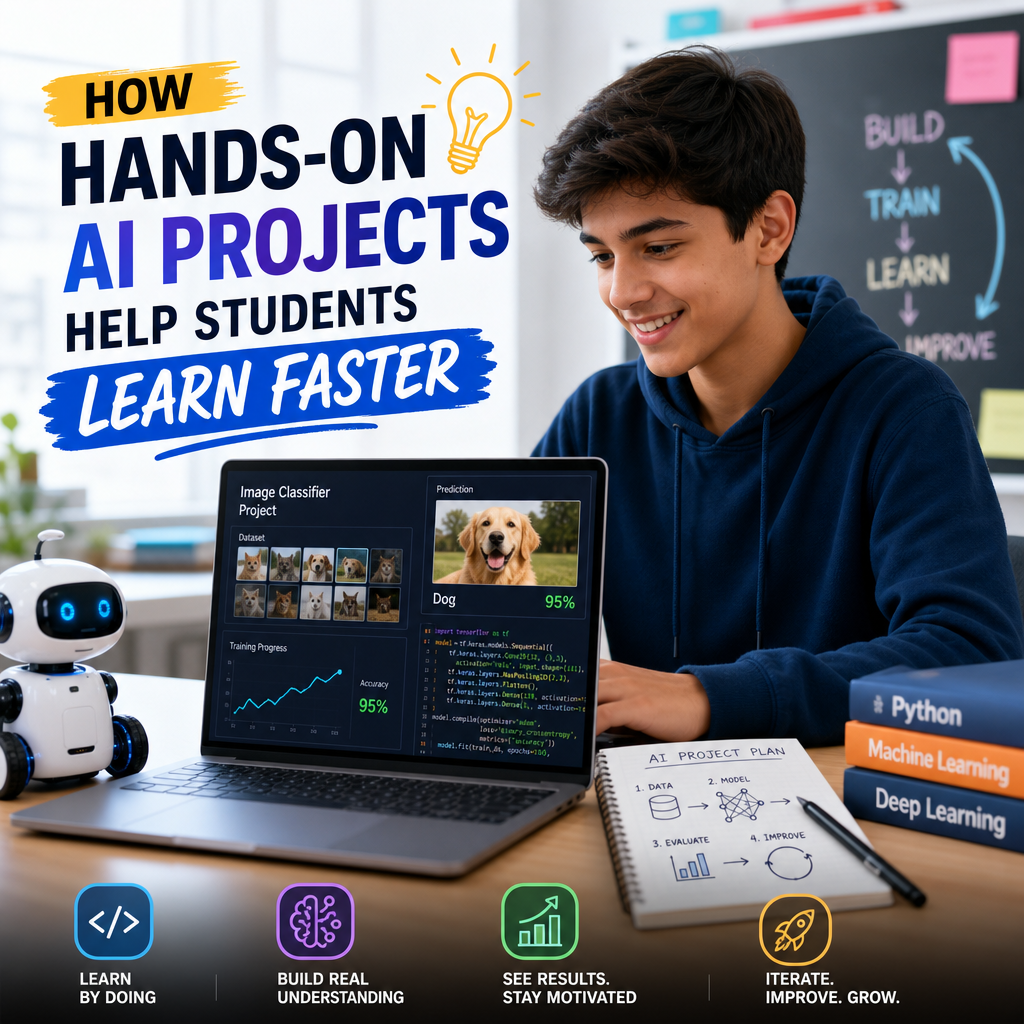
Reading about machine learning is not the same as training a simple model. Watching a lesson on computer vision is very different from building an image classifier and testing how it performs.
Many students struggle because AI includes topics that seem technical and distant at first, such as:
- data preprocessing
- neural networks
- model evaluation
- algorithm selection
- bias and accuracy trade-offs
When these ideas stay inside a textbook, they can feel disconnected. But when students apply them in a project, each concept gains purpose. They are no longer just learning what AI is. They are learning how it works.
Projects Turn Abstract Concepts Into Real Experience
One of the biggest benefits of hands-on AI projects is that they make difficult ideas easier to understand. A student building a chatbot, for example, quickly learns why clean data matters. A student creating a recommendation tool begins to see how patterns are identified and used.
This kind of learning works because projects provide immediate context.
Students See Cause and Effect
When students change a variable, adjust training data, or test a new model, they can observe the result right away. That instant feedback helps them connect action with outcome.
For example, they might discover that:
- poor-quality data leads to weak predictions
- too little training data reduces accuracy
- overcomplicated models do not always perform better
- small adjustments can improve results significantly
These discoveries are powerful because students arrive at them through experience, not just explanation.
Active Learning Builds Stronger Memory
People tend to remember what they do more than what they hear. Hands-on work uses problem-solving, experimentation, and repetition, which strengthens memory and understanding.
When students work on AI projects, they often repeat important skills naturally, such as:
- organizing datasets
- writing and testing code
- debugging model errors
- interpreting output
- improving performance over time
Each step reinforces learning. Instead of reviewing concepts once for a test, students revisit them throughout the project. That repetition makes knowledge stick.
AI Projects Improve Motivation
Motivation plays a huge role in how quickly students learn. If a lesson feels irrelevant, attention drops. If a task feels meaningful, students usually stay engaged longer.
Hands-on AI projects often feel exciting because they lead to something visible and real. A student might create:
- a spam email detector
- a movie recommendation system
- a face recognition app
- a sentiment analysis tool
- a simple AI-powered game feature
These are not just classroom exercises. They feel like things people actually use. That sense of relevance gives students a stronger reason to keep learning.
Progress Feels More Rewarding
Traditional study methods can make progress hard to notice. With projects, students can see improvement step by step. Their code works better. Their model becomes more accurate. Their final tool becomes more useful.
That visible progress creates confidence, and confidence helps students learn faster.
Problem-Solving Skills Grow Alongside Technical Skills
AI is not just about learning tools. It also requires students to think critically, ask questions, and adapt when things go wrong. Projects naturally build these habits.
In a hands-on setting, students learn to:
- define a problem clearly
- choose a practical approach
- test different ideas
- evaluate the results
- improve based on feedback
These are valuable skills in school and in future careers. Students are not simply following instructions. They are learning how to think like builders and analysts.
Collaboration Makes Learning Even Faster
Many hands-on AI projects involve teamwork, which adds another layer of learning. Students explain ideas to one another, compare solutions, and troubleshoot together.
This collaboration helps in several ways:
- it exposes students to different ways of thinking
- it makes difficult problems feel more manageable
- it improves communication skills
- it encourages peer learning
Sometimes a classmate can explain a concept in a way that feels more approachable than a lecture. Group work also mirrors the way AI is developed in real workplaces, where collaboration is essential.
Failure Becomes Part of the Learning Process
One reason hands-on AI projects are so effective is that they make failure useful. In AI, first attempts rarely work perfectly. Models underperform. Data is messy. Results can be unexpected.
That might sound frustrating, but it is actually a major learning advantage.
Students learn that failure is not a dead end. It is information. Each mistake reveals something new about the problem, the data, or the method. This mindset encourages resilience and curiosity, both of which speed up learning over time.
Final Thoughts
Hands-on AI projects help students learn faster because they transform passive study into active discovery. They turn complex ideas into practical experiences, strengthen memory through repetition, and boost motivation by making learning feel real.
More importantly, they help students build confidence. Instead of wondering whether they understand AI, they can prove it by creating something that works.
When students learn by doing, they do not just absorb information more quickly. They develop the skills, habits, and mindset needed to keep learning long after the project is complete.