

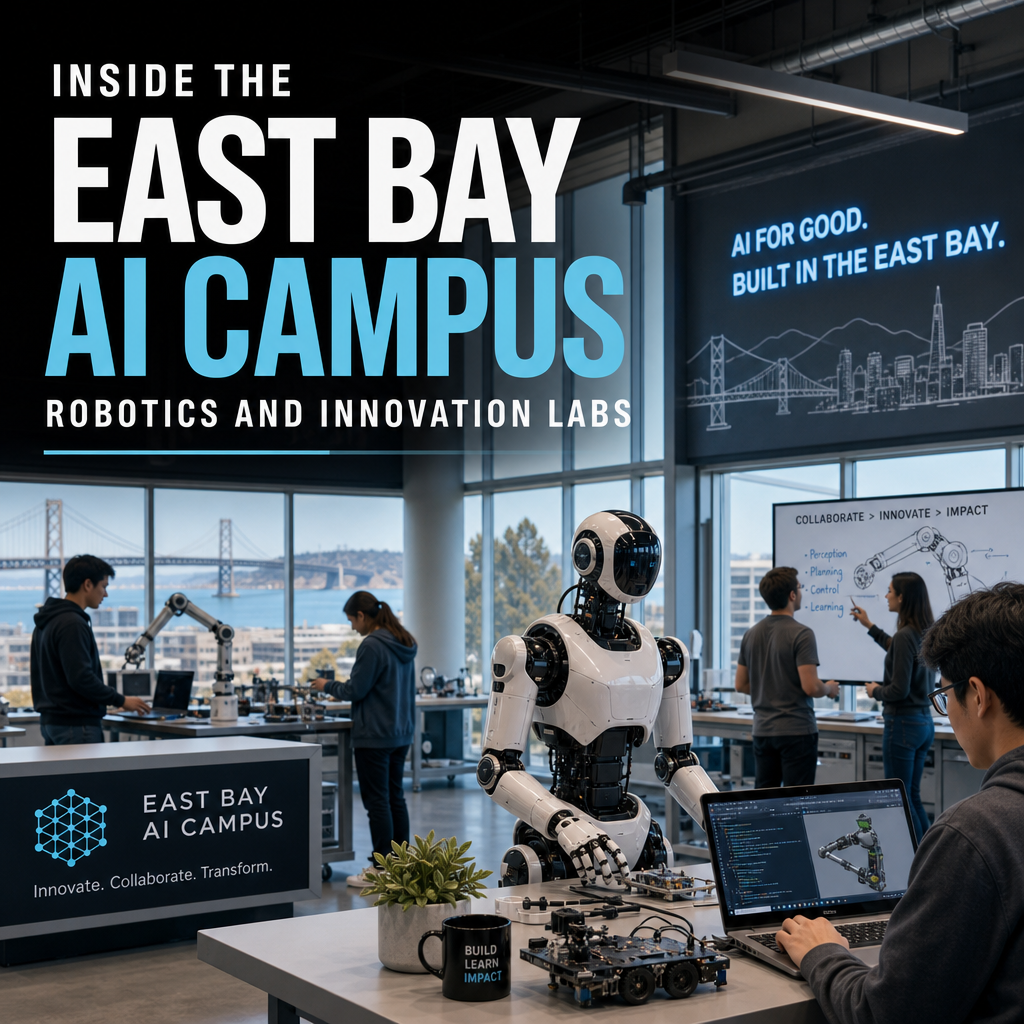
Inside the East Bay AI Campus Robotics and Innovation Labs
A First Look Inside the East Bay AI Campus
The East Bay AI Campus was built to be more than a collection of classrooms and labs. It is a place where ideas move quickly from whiteboards to working prototypes, where students and researchers collaborate across disciplines, and where robotics and artificial intelligence are explored through hands-on experimentation.
From autonomous systems to intelligent sensing, the campus brings together the tools, space, and talent needed to support real innovation. A visit inside reveals a learning environment designed for curiosity, problem-solving, and practical impact.
Where Robotics Meets Real-World Problem Solving
At the heart of the East Bay AI Campus are the Robotics & Innovation Labs, where theory becomes physical. These spaces are designed to support every stage of the development process, from concept design and coding to testing and refinement.
Instead of separating engineering, software, and research into isolated departments, the labs encourage interdisciplinary work. Students building robotic arms can collaborate with AI developers working on computer vision. Teams focused on mobility can test their systems alongside those designing machine learning models for object recognition.
This integrated approach helps accelerate progress and gives learners a more realistic view of how modern innovation happens.
Inside the Robotics Labs
The robotics labs are equipped to support a wide range of projects, whether teams are building small mobile robots, experimenting with automation, or testing advanced sensing systems.
Core Lab Features
Some of the most exciting elements of the robotics spaces include:
- Open prototyping stations for rapid hardware development
- Testing zones for autonomous navigation and movement
- Workbenches for electronics, sensors, and embedded systems
- Collaborative build areas for team-based projects
- Simulation tools that allow systems to be modeled before physical deployment
These features create a flexible environment where students can move from experimentation to iteration without losing momentum.
A Hands-On Learning Environment
One of the defining qualities of the robotics labs is the emphasis on active learning. Instead of only studying robotic systems in theory, students engage directly with the technologies they are exploring.
That might mean programming a robot to respond to visual input, calibrating sensors for a new application, or troubleshooting mechanical performance in real time. This hands-on process builds both technical confidence and practical problem-solving skills.
The Innovation Labs: Designed for Big Ideas
Beyond robotics, the Innovation Labs at the East Bay AI Campus support a broader range of AI-driven exploration. These spaces are intentionally flexible, making room for startups, student capstones, faculty-led research, and collaborative industry projects.
The Innovation Labs are often where early ideas take shape. A concept for an assistive robot, a smart monitoring system, or an AI-powered data tool can begin as a simple discussion and quickly evolve into a working model.
What Happens in the Innovation Labs?
Projects in these spaces often focus on areas such as:
- Artificial intelligence and machine learning
- Human-robot interaction
- Computer vision applications
- Smart devices and connected systems
- Ethical and responsible technology design
Because these labs are built for experimentation, teams are encouraged to test assumptions, fail safely, and improve continuously.
Collaboration Is Part of the Campus Culture
One of the most valuable aspects of the East Bay AI Campus is its collaborative atmosphere. Innovation rarely happens in isolation, and the campus reflects that reality.
Students, mentors, researchers, and technical staff work in close proximity, creating frequent opportunities for feedback and cross-pollination of ideas. A robotics team might receive input from an AI specialist. A software researcher may partner with a hardware designer to bring a concept to life.
This culture of collaboration helps foster:
- Faster iteration on projects
- Broader exposure to multiple disciplines
- Stronger communication and teamwork skills
- More creative approaches to technical challenges
In many ways, the shared energy of the campus is just as important as the technology itself.
Preparing Students for the Future of AI and Robotics
The Robotics & Innovation Labs are not only about invention. They are also about preparation. As industries increasingly rely on automation, intelligent systems, and data-driven decision-making, students need more than academic knowledge. They need real experience.
By working in the labs, students develop skills that translate directly into future careers, including:
Key Skills Built in the Labs
- Prototyping and systems design
- Coding and AI model development
- Testing, debugging, and refinement
- Team collaboration and project management
- Ethical thinking around emerging technologies
This combination of technical and practical training helps learners leave the campus ready to contribute in meaningful ways.
A Space Built for What Comes Next
The East Bay AI Campus represents a forward-looking approach to education and innovation. Its Robotics & Innovation Labs are more than specialized facilities; they are launchpads for discovery.
Whether a student is building a first prototype, a research team is refining a complex autonomous system, or a new partnership is exploring what AI can do next, the campus offers the environment to make that work possible.
In a field that changes rapidly, spaces like these matter. They give people room to test ideas, learn by doing, and build technology with purpose. Inside the East Bay AI Campus, that future is already taking shape.