
Dublin’s First AI Campus: How It Differs From Traditional Learning Centers
Dublin’s First AI Campus: What Makes It Different from Traditional Learning Centers
Artificial intelligence is changing how people work, build businesses, and solve problems. As demand for practical AI skills grows, education is also evolving. That is why Dublin’s First AI Campus stands out. Rather than following the model of a traditional learning center, it is designed to reflect how modern technology is actually learned and applied in the real world.
For students, professionals, and entrepreneurs, this shift matters. The difference is not just in what is taught, but in how people learn, collaborate, and prepare for the future.
A Learning Environment Built Around AI
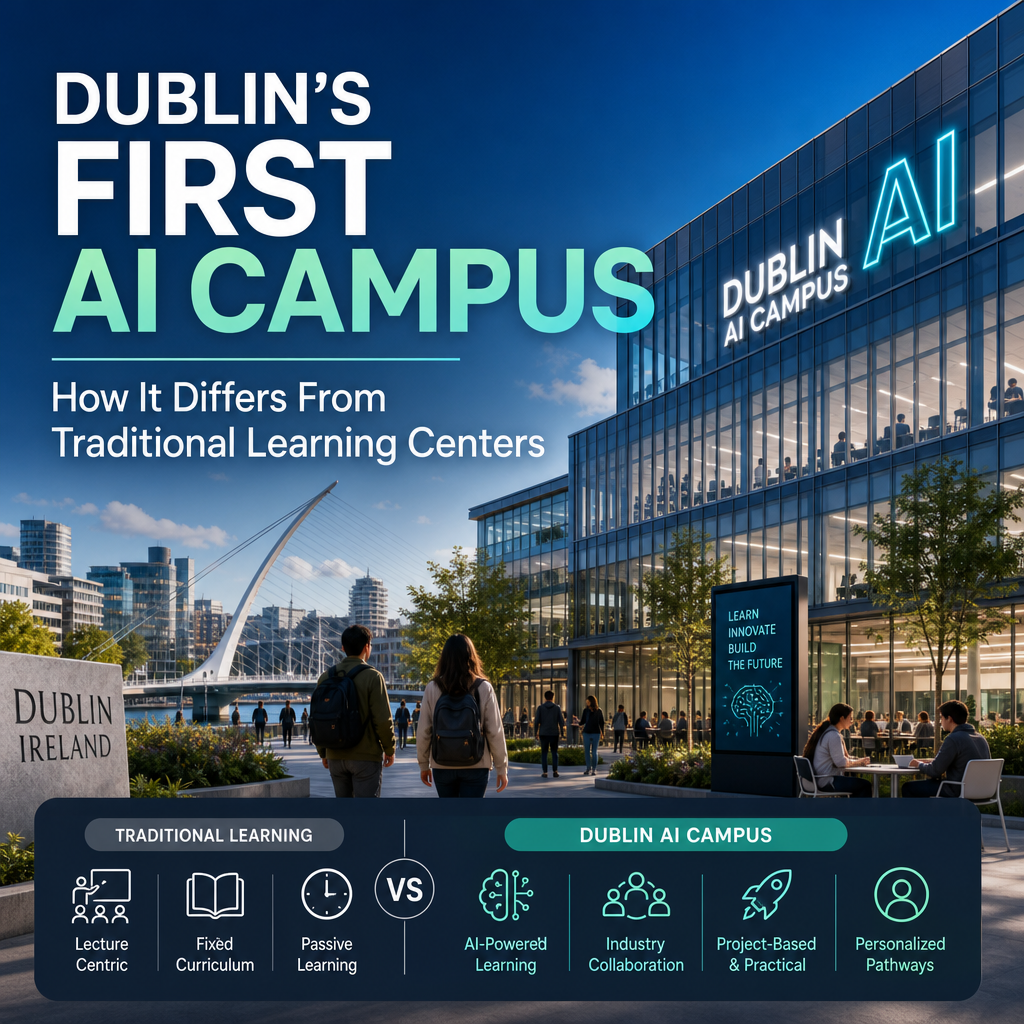
Traditional learning centers often rely on fixed curricula, classroom lectures, and general-purpose facilities. While these methods can still be useful, they are not always ideal for a field that changes as quickly as artificial intelligence.
Dublin’s First AI Campus is different because it is built specifically for AI-focused learning. That means the campus experience is shaped around experimentation, problem-solving, and hands-on work with emerging tools.
Instead of treating AI as one subject among many, the campus places it at the center of the learning journey. This creates an environment where students are constantly surrounded by the technologies, conversations, and challenges that define the industry.
More Than Classrooms
One of the biggest differences between an AI campus and a traditional learning center is the type of space available.
A conventional learning center may offer:
- Standard lecture rooms
- Computer labs with fixed software
- Limited project collaboration areas
- A syllabus-first learning model
By contrast, Dublin’s First AI Campus is likely to emphasize:
- Flexible innovation spaces
- AI labs for testing real tools and models
- Project-based collaboration zones
- Access to mentors, startups, and industry experts
This matters because AI is not learned through theory alone. It requires testing ideas, working with data, refining prompts, building prototypes, and learning from failure. A campus built around that process creates a stronger bridge between education and practice.
A Stronger Connection to Industry
Traditional learning centers often focus on academic delivery first and industry engagement second. In many cases, students complete coursework without fully understanding how those skills connect to the workplace.
An AI campus changes that dynamic.
Real-World Relevance
Because AI is moving so quickly, learners need exposure to current tools, real business use cases, and practical applications. Dublin’s First AI Campus can offer a more direct connection between learning and employment by aligning programs with industry demand.
That may include:
- Guest sessions from AI founders and practitioners
- Partnerships with technology companies
- Live industry projects
- Workshops on ethical AI, automation, and product development
This kind of ecosystem helps students move beyond theory and into applied knowledge. They are not just learning what AI is. They are learning how it is used in business, healthcare, finance, education, and creative industries.
Interdisciplinary Learning Instead of Isolated Subjects
Another major difference is the way subjects are combined.
Traditional learning centers often separate disciplines into neat categories. AI, however, does not work that way. It touches programming, design, ethics, business strategy, mathematics, communication, and policy.
Why This Approach Matters
At Dublin’s First AI Campus, interdisciplinary learning can become a natural part of the experience. A student might work on a technical model while also considering user experience, privacy, and commercial value.
This kind of structure better reflects the real world, where successful AI projects depend on more than technical skill alone.
Learners benefit from:
- Broader problem-solving abilities
- Better teamwork across different backgrounds
- A deeper understanding of AI’s social and business impact
- Greater readiness for hybrid roles in the job market
A Community, Not Just a Course Provider
Traditional learning centers often operate as places people visit for classes and then leave behind. An AI campus has the potential to feel more like a community.
That sense of community can make a major difference in a fast-changing field. People learning AI often need ongoing support, shared experimentation, and access to peers who are exploring similar questions.
Collaboration Drives Better Learning
In a campus environment designed around AI, learners can connect with:
- Fellow students
- Founders and innovators
- Researchers
- Employers
- Technical mentors
These connections can lead to partnerships, startup ideas, internships, and long-term career opportunities. In that sense, Dublin’s First AI Campus is not just a place to gain knowledge. It can become a place to build a network and grow within an emerging tech ecosystem.
Faster Adaptation to Change
One challenge for traditional learning centers is that formal courses can become outdated quickly. AI tools, platforms, and best practices are evolving all the time.
A dedicated AI campus is better positioned to adapt. Programs can be updated more frequently, workshops can respond to new developments, and learners can stay closer to the cutting edge.
This flexibility is essential. In AI education, relevance matters just as much as quality. A campus focused on innovation is more likely to keep pace with what employers and creators actually need.
Why It Matters for Dublin
Dublin has already built a strong reputation as a European technology hub. The arrival of Dublin’s First AI Campus adds something new to that story. It signals a move toward specialized, future-facing education that supports both talent development and innovation.
For the city, this could mean:
- A stronger pipeline of AI-ready professionals
- More support for startups and digital transformation
- Increased collaboration between education and industry
- A stronger position in the global AI conversation
Final Thoughts
The difference between Dublin’s First AI Campus and a traditional learning center comes down to purpose. Traditional centers are often designed to deliver education. An AI campus is designed to create immersion, collaboration, and real-world readiness.
As artificial intelligence becomes a bigger part of everyday life and work, that distinction becomes increasingly important. Learners do not just need information. They need environments that help them experiment, adapt, and build confidently for the future.
That is what makes this new model worth watching.