
How AI Literacy Improves Academic Performance in All Subjects
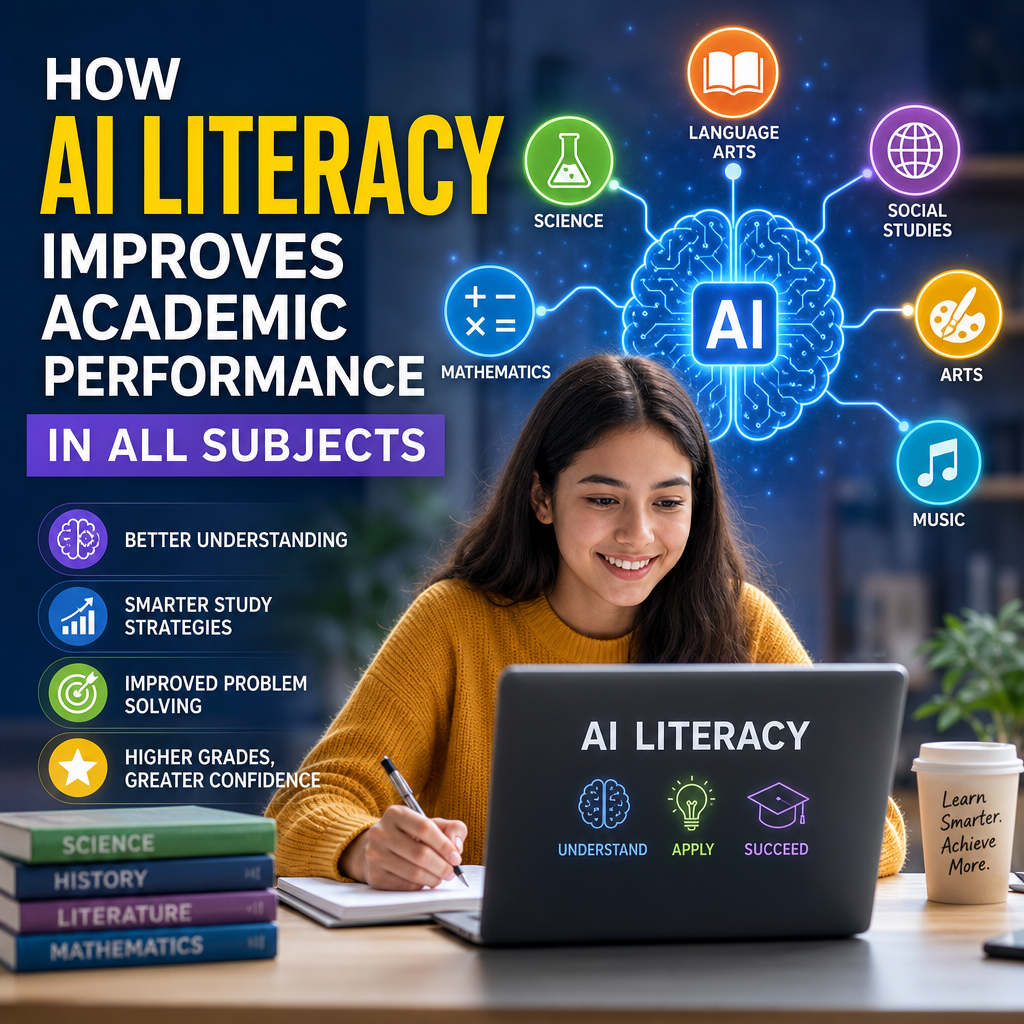
How AI Literacy Improves Academic Performance Across All Subjects
AI is no longer just a topic for computer science classrooms. It is becoming a practical study skill that can support learning in math, science, literature, history, and even the arts. As schools and universities adopt more digital tools, AI literacy is quickly turning into an essential part of academic success.
Students who understand how to use AI responsibly often learn faster, study more effectively, and develop stronger critical thinking skills. That is why AI literacy improves academic performance across all subjects.
What Is AI Literacy?
AI literacy is the ability to understand, evaluate, and use artificial intelligence tools in an informed and responsible way. It does not mean students need to become programmers or machine learning experts.
Instead, it includes skills such as:
- Knowing what AI can and cannot do
- Asking better questions to get useful results
- Checking AI-generated information for accuracy
- Understanding bias, limitations, and ethical concerns
- Using AI as a support tool rather than a shortcut
In simple terms, AI literacy helps students become smarter users of technology instead of passive consumers.
Better Research Skills in Every Subject
One of the biggest ways AI literacy improves academic performance is by strengthening research skills. Students often struggle with where to start, how to organize information, and how to identify reliable sources.
AI tools can help students:
- Break down complex topics into smaller questions
- Generate summaries of difficult concepts
- Compare viewpoints on an issue
- Create study guides from notes
For example, a history student can use AI to outline the causes of a major event, while a biology student can ask for a simpler explanation of cell division. A literature student might use it to explore themes, symbols, or character development.
However, AI literacy matters because students must still verify facts, recognize weak answers, and avoid relying on inaccurate summaries. This process builds stronger independent thinking.
Stronger Writing and Communication
Writing is part of nearly every subject, from lab reports to essays and reflections. Students with AI literacy can use tools to improve grammar, structure, clarity, and vocabulary without losing their own voice.
This can be especially helpful when students need to:
Organize Ideas More Clearly
AI can suggest outlines, topic sentences, and transitions. That gives students a stronger starting point when they feel stuck.
Improve Drafts
Students can ask for help identifying repeated words, awkward phrasing, or unclear arguments. This makes revision more focused and productive.
Build Confidence
For many learners, especially multilingual students, AI can reduce the stress of writing by offering immediate feedback and support.
The key is that AI should assist the writing process, not replace it. Students still need to develop original arguments, interpret evidence, and communicate their own understanding.
More Personalized Learning
Every student learns differently. Some need more examples, while others benefit from simpler explanations or step-by-step guidance. AI literacy improves academic performance because it allows students to adapt learning to their own needs.
A student who struggles with algebra can ask for multiple practice problems at different difficulty levels. Another student preparing for a chemistry test can request quick quizzes based on class notes. In language learning, AI can support vocabulary practice, conversation exercises, and instant corrections.
This kind of personalized help can make learning feel more manageable and less frustrating. It also helps students become more active in their own progress.
Critical Thinking Becomes Even More Important
Some people worry that AI makes students lazy. In reality, when used well, AI literacy can strengthen critical thinking.
Students must learn to ask:
- Is this answer accurate?
- What is missing from this explanation?
- Does this source seem trustworthy?
- Is the AI oversimplifying the topic?
- What evidence supports this claim?
These questions are valuable in every discipline. In science, students evaluate whether explanations match accepted knowledge. In social studies, they consider perspective and bias. In English, they assess interpretation and nuance.
AI literacy teaches students not to accept information automatically. That habit supports stronger academic performance over time.
Support for STEM, Humanities, and Creative Subjects
The benefits of AI literacy are not limited to one area of study.
STEM Subjects
In math and science, AI can explain formulas, walk through problem-solving steps, and generate practice questions. Students can review mistakes and identify gaps in understanding more quickly.
Humanities
In history, literature, philosophy, and social science, AI can help students compare ideas, summarize readings, and explore multiple interpretations. This can make dense material easier to approach.
Creative Subjects
In art, music, and design, AI can support brainstorming, feedback, and experimentation. Students can explore new ideas while still developing their own creative judgment.
Because AI tools are flexible, students can apply them across almost every academic task.
Responsible Use Matters
To truly benefit from AI, students need guidance on responsible use. Without that, AI can lead to weak learning habits, plagiarism, or overdependence.
Healthy AI use includes:
- Using AI for support, not substitution
- Citing tools when required
- Verifying facts with trusted sources
- Protecting privacy and personal data
- Following school or university policies
When students understand these boundaries, they are more likely to use AI in ways that improve learning rather than undermine it.
Final Thoughts
AI literacy improves academic performance by helping students research better, write more clearly, learn more personally, and think more critically. It gives learners practical tools that can support success in every subject area.
As education continues to evolve, AI literacy will become just as important as digital literacy and information literacy. Students who know how to use AI wisely will not only perform better in class, but also develop skills that will serve them well beyond school.