
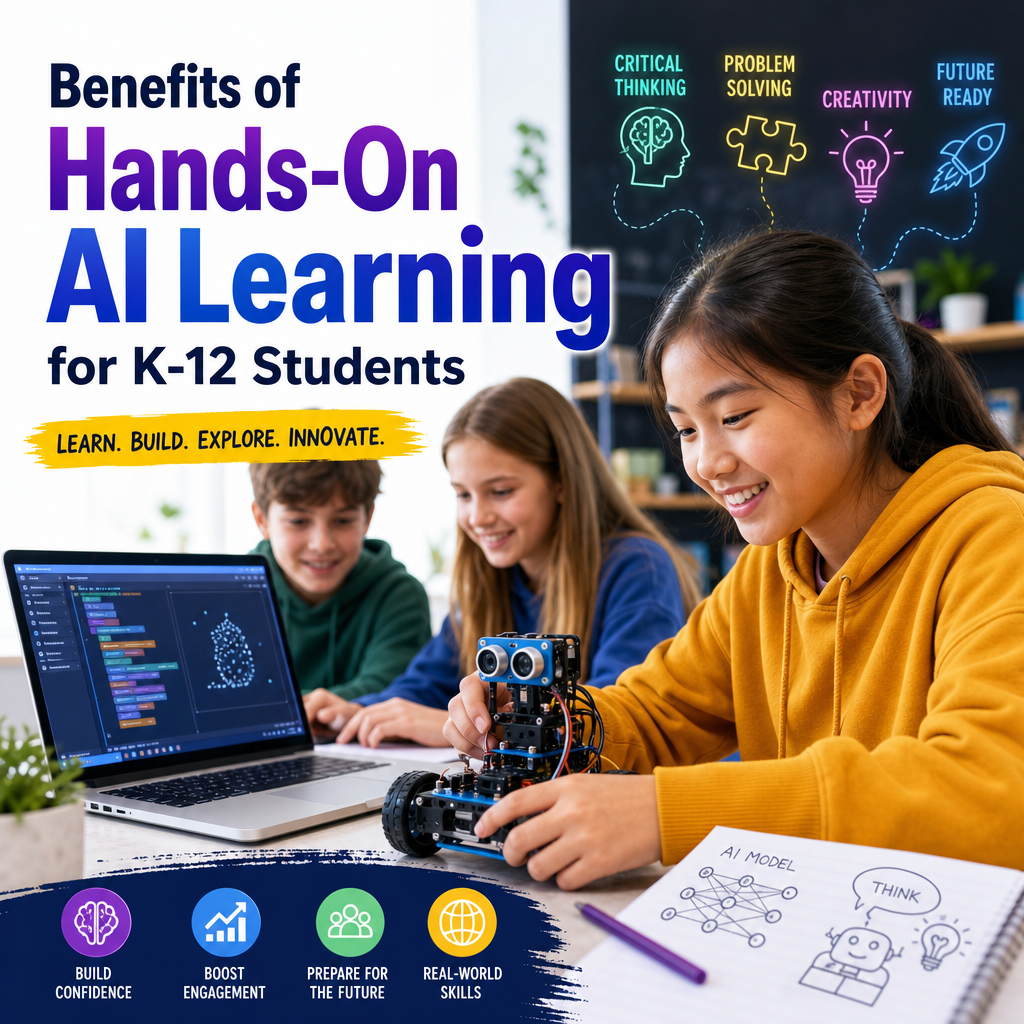
Benefits of Hands-On AI Learning for K-12 Students
The Benefits of Hands-On AI Learning for K-12 Students
Artificial intelligence is no longer a future concept. It is already part of how students search online, watch videos, use learning apps, and interact with digital tools every day. Because of that, schools have a growing opportunity to move beyond simply talking about AI and start giving students direct experience with it.
Hands-on AI learning helps K-12 students understand how these systems work, how to use them responsibly, and how they can shape the future. When students learn by building, testing, and exploring AI tools, the experience becomes more meaningful than a lecture or textbook explanation alone.
Why Hands-On AI Learning Matters
Students learn best when they are actively involved. That is especially true with emerging technology.
Hands-on AI learning turns abstract ideas into real experiences. Instead of only hearing that AI can recognize images, students can train a model to sort photos. Instead of reading about chatbots, they can design one. These activities make AI less intimidating and more approachable.
This kind of learning also helps students move from passive technology users to informed creators. They begin to see that AI is not magic. It is built from data, rules, patterns, and human decisions.
Building Problem-Solving Skills
One of the biggest benefits of hands-on AI learning is that it strengthens problem-solving.
When students work with AI projects, they often need to:
- Define a problem clearly
- Gather and organize data
- Test different solutions
- Analyze results
- Improve their approach
These are valuable skills across all subjects, not just computer science.
For example, a class might create a simple AI model to identify plant species or sort recycling materials. In the process, students learn how to ask better questions, notice patterns, and think critically about why a model succeeds or fails.
That type of trial-and-error learning builds persistence and confidence.
Encouraging Creativity and Curiosity
AI education is not only about coding. It can also support creativity.
Students can use AI in art, music, storytelling, science investigations, and design projects. A younger student might explore how an image-recognition tool sees shapes and colors. An older student might build a project that uses AI to recommend books, translate text, or create interactive experiences.
These activities spark curiosity because students can connect AI to their own interests.
Hands-on AI learning gives students room to experiment. They can ask “what happens if I change this?” and immediately see the result. That feedback loop makes learning engaging and memorable.
Teaching Digital Literacy and Responsible Use
As AI tools become more common, students need more than technical knowledge. They also need digital literacy.
Hands-on AI learning creates the perfect setting to teach students how AI systems can be helpful, but also limited. They can explore important questions such as:
How does AI make decisions?
Students can learn that AI models depend on data and patterns, not human understanding.
Can AI be biased?
By seeing how training data affects outcomes, students begin to understand fairness, bias, and why diverse data matters.
When should people trust AI?
Students can discuss why human judgment is still essential, especially in areas like health, education, and safety.
These lessons are important for every grade level. Even simple classroom activities can introduce the idea that technology should be used thoughtfully and ethically.
Supporting Career Readiness Early
Not every student will become an AI engineer, but nearly every student will enter a world shaped by AI.
That makes early exposure valuable. Hands-on AI learning introduces students to ideas and tools they may encounter later in college, careers, or daily life. It also helps them see that technology careers are broader than they may have imagined.
Students may discover interests in:
- Programming
- Data science
- Robotics
- Graphic design
- User experience
- Ethics and policy
- Education technology
By starting in K-12, schools can make these pathways feel more accessible. Students gain familiarity and confidence long before they have to make future academic or career choices.
Making Learning More Relevant Across Subjects
AI does not need to stay in one classroom.
Teachers can integrate hands-on AI learning into many subjects. In science, students can analyze environmental data. In math, they can study patterns and prediction. In language arts, they can evaluate AI-generated text and discuss credibility. In social studies, they can examine how technology affects society.
This cross-curricular approach helps students understand that AI is not separate from the real world. It is part of the systems, tools, and decisions that influence everyday life.
That relevance increases student engagement because the learning feels connected to what they already know and care about.
Creating Confident, Informed Learners
Perhaps the greatest benefit of hands-on AI learning is confidence.
When students experiment with AI themselves, they stop seeing it as something mysterious controlled only by experts. They start to understand that they can question it, evaluate it, and even build with it.
That sense of agency matters.
K-12 students do not just need access to technology. They need opportunities to understand it deeply enough to participate in the future it is shaping. Hands-on AI learning gives them that chance by combining technical skills, critical thinking, creativity, and ethical awareness.
Final Thoughts
The benefits of hands-on AI learning for K-12 students go far beyond learning a new tool. It helps students become better thinkers, more responsible digital citizens, and more confident problem-solvers.
As AI continues to influence education and everyday life, giving students practical experience now can prepare them for a future where understanding technology is just as important as using it.