
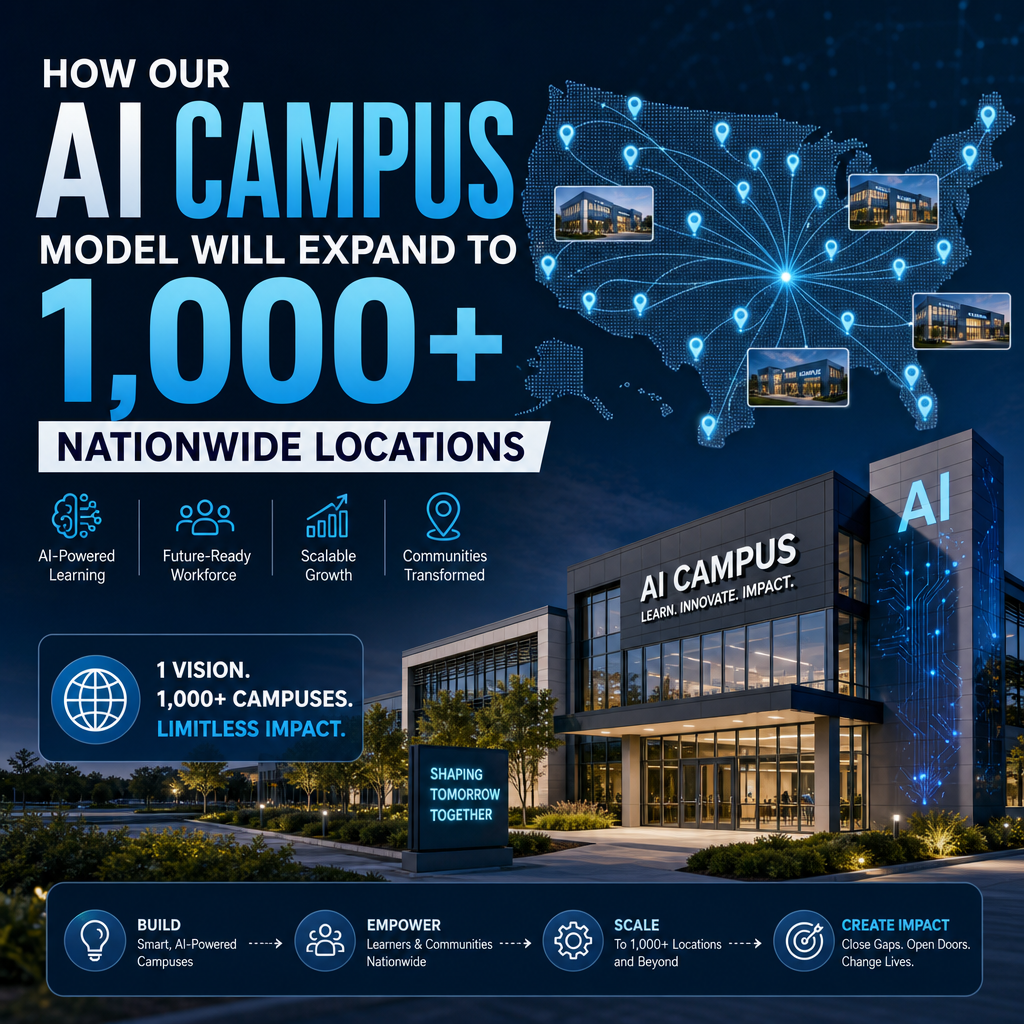
How Our AI Campus Model Will Expand to 1,000+ Nationwide Locations
The East Bay AI Campus Model started with a simple idea: make practical AI education, startup support, and workforce development available in one local, community-centered hub.
What began as a regional concept is now becoming a national blueprint. As demand for AI skills grows across industries, communities need more than online courses or occasional workshops. They need places where students, founders, professionals, and local employers can learn, build, and collaborate together.
That is exactly why the East Bay AI Campus Model is designed to scale to 1,000+ locations nationwide.
Why This Model Is Ready to Scale
The biggest reason this model can expand quickly is that it is built around repeatable systems rather than one-off programs.
Each campus is designed to deliver the same core value:
- AI education for learners at different levels
- Hands-on training tied to real-world tools
- Startup incubation and mentorship
- Community events and employer partnerships
- Local pathways into jobs, projects, and innovation
Instead of reinventing the wheel in every city, the East Bay AI Campus Model uses a framework that can be adapted to local needs while keeping the mission consistent.
That balance matters. A campus in a major metro area may focus on enterprise AI and startup acceleration, while a campus in a smaller market may prioritize workforce upskilling, small business adoption, and technical training. The structure stays the same, but the programming can reflect the local economy.
The Core Building Blocks of Expansion
Scaling to 1,000+ locations requires more than vision. It requires an operating model that is simple, flexible, and sustainable.
1. A Standardized Campus Framework
Every new location can launch from a proven foundation. That includes:
- Curriculum templates
- Event formats
- Partnership models
- Membership structures
- Mentor and instructor guidelines
- Technology and operational tools
This allows new campuses to open faster and with less friction. It also makes quality control much easier across a growing network.
2. Local Leadership, National Support
One of the strengths of the East Bay AI Campus Model is that it does not rely on a single centralized team to do everything.
Instead, local operators, educators, and community leaders drive each campus on the ground. They understand the workforce needs, business climate, and education gaps in their region. At the same time, they benefit from national support, shared resources, brand standards, and proven playbooks.
This approach creates a network effect. Each location becomes stronger because it is part of something larger.
3. Multiple Audience Segments
The model is not limited to one type of learner. That gives it broader reach and stronger long-term viability.
A single campus can serve:
- High school and college students
- Career changers
- Working professionals
- Entrepreneurs and startup teams
- Small business owners
- Corporate partners
- Public sector and nonprofit organizations
That diversity helps each location remain active, relevant, and financially resilient.
Why Communities Across the Country Need This Now
AI is no longer a niche topic. It is becoming a foundational skill set for modern work.
Businesses want employees who can use AI tools effectively. Entrepreneurs want support building AI-enabled companies. Schools want stronger pathways into emerging careers. Workers want practical training that leads to opportunity, not just theory.
The problem is access. In many communities, AI learning is either too abstract, too expensive, or too disconnected from local jobs.
The East Bay AI Campus Model addresses that gap by bringing AI access closer to where people live and work. Instead of expecting communities to plug into distant innovation centers, this model helps create innovation hubs inside those communities.
How 1,000+ Locations Becomes Real
National expansion happens in phases, not all at once.
Phase One: Regional Clusters
The first stage focuses on building strong clusters in strategic markets. These may include:
- Major metros with strong startup ecosystems
- Suburban regions with growing professional populations
- Underserved communities with workforce development needs
- College-centered cities ready for innovation partnerships
Launching in clusters creates operational efficiency and regional visibility.
Phase Two: Partnerships and Replication
Once the framework is validated across different environments, growth accelerates through partnerships with:
- Educational institutions
- Municipal organizations
- Economic development groups
- Employers and workforce boards
- Community-based organizations
- Real estate and coworking partners
These relationships make it easier to identify locations, recruit leaders, and launch programming quickly.
Phase Three: National Network Effects
At scale, the network becomes more valuable for everyone involved.
Students gain access to broader opportunities. Startups can connect with mentors and investors across markets. Employers can recruit from a national talent pipeline. Local campuses can share best practices, content, and partnerships.
That is when the East Bay AI Campus Model evolves from a set of locations into a true national platform.
What Success Will Look Like
Success is not just measured by the number of campuses opened.
It will also be measured by outcomes such as:
- People trained in applied AI skills
- Startups launched and supported
- Employers connected to local talent
- Communities gaining access to innovation infrastructure
- Regional economies strengthened through technology adoption
In other words, the goal is not expansion for its own sake. The goal is to build a system that creates lasting local impact at national scale.
The Bigger Vision
The East Bay AI Campus Model is expanding because the country needs a more distributed, inclusive approach to AI education and innovation.
For too long, access to emerging technology has been concentrated in a handful of places. A nationwide campus network changes that. It creates local doors into a global future.
Reaching 1,000+ locations is an ambitious target, but the need is real, the model is practical, and the timing is right. By combining standardized systems, local leadership, and community-first programming, this model has the potential to reshape how America learns, builds, and grows in the age of AI.