

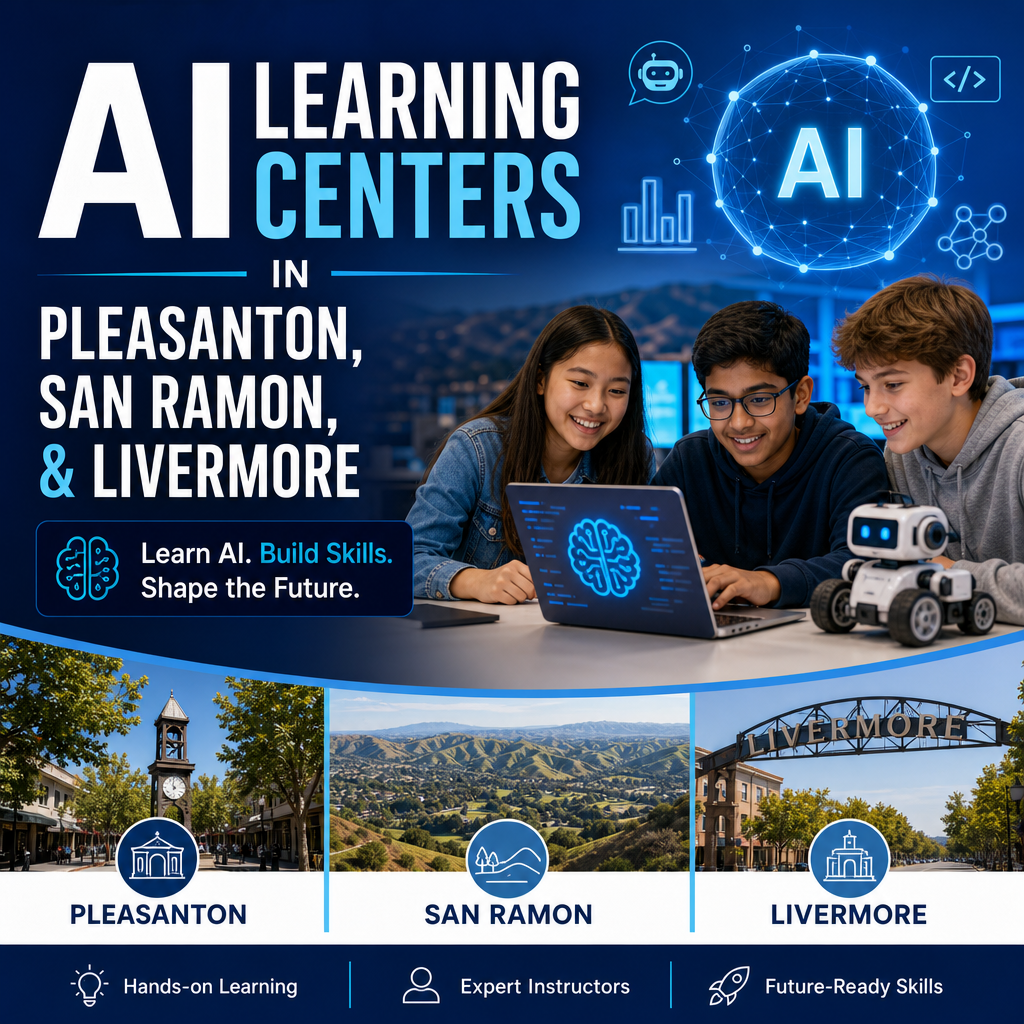
AI Learning Centers in Pleasanton, San Ramon, and Livermore
The Rise of AI Learning Centers in Pleasanton, San Ramon & Livermore
Artificial intelligence is no longer a far-off concept discussed only in tech circles. It is quickly becoming part of how students learn, build, and prepare for the future. That shift is especially visible in the Tri-Valley, where AI learning centers in Pleasanton, San Ramon & Livermore are gaining attention from families, educators, and students alike.
These centers are helping young learners move beyond passive screen time and into hands-on problem solving. From coding and robotics to machine learning basics, students are being introduced to the skills that will shape tomorrow’s careers.
Why AI Education Is Growing in the Tri-Valley
Pleasanton, San Ramon, and Livermore have long been known for strong schools, family-focused communities, and proximity to innovation-driven industries. It makes sense that parents in these cities are looking for ways to give their children an early advantage in technology.
AI learning centers are filling that need by offering structured, age-appropriate programs that go beyond traditional tutoring. Instead of focusing only on grades or test prep, these programs often emphasize:
- Computational thinking
- Creative problem solving
- Real-world technology applications
- Collaboration and project-based learning
- Confidence with emerging tools
For many families, that combination is hard to ignore.
What AI Learning Centers Actually Teach
One reason AI learning centers in Pleasanton, San Ramon & Livermore are growing so quickly is that they make advanced topics feel accessible. Students do not need to be expert programmers to get started.
Most centers introduce AI concepts in a gradual, engaging way. Younger students may begin with logic games, robotics, and beginner coding. Older students often explore more advanced topics such as:
Machine Learning Basics
Students learn how computers identify patterns, make predictions, and improve with data. This may include simple image recognition or recommendation systems.
Coding for AI Applications
Languages like Python are commonly used because they are beginner-friendly and widely used in AI development.
Robotics and Automation
Many centers combine AI with robotics, allowing students to see how software controls physical systems.
Data Literacy
Understanding data is a major part of AI education. Students may learn how to collect, organize, and interpret information.
Ethical Use of AI
As AI becomes more common, it is equally important to discuss responsible use, bias, privacy, and digital citizenship.
Why Parents Are Paying Attention
Parents are increasingly aware that future jobs will look different from today’s jobs. Even children who do not become software engineers will likely work alongside AI tools in healthcare, finance, education, design, and many other industries.
That is why AI learning centers are being viewed as more than enrichment. They are becoming part of a broader educational strategy.
Families are drawn to programs that help students:
- Build comfort with technology early
- Learn by doing instead of memorizing
- Develop resilience through experimentation
- Strengthen logical and analytical thinking
- Create projects they can be proud of
In many cases, students also discover that technology can be creative, not just technical.
A Good Fit for Different Types of Learners
Another reason for the rise of AI learning centers in Pleasanton, San Ramon & Livermore is their flexibility. Traditional classroom environments do not always match every student’s learning style. AI centers often offer smaller groups, personalized instruction, and project-based formats that can be more engaging.
Some students thrive because they enjoy structured logic. Others are drawn in by the creativity of building games, chatbots, or robots. Even students who may not think of themselves as “tech kids” often respond positively when they see how AI connects to art, storytelling, science, or entrepreneurship.
This broader appeal is helping AI education move into the mainstream.
Local Communities Are Well Positioned for This Trend
The Tri-Valley region is especially well positioned to support this movement. With its mix of high-performing schools, involved parents, and access to the greater Bay Area’s innovation ecosystem, demand for future-focused education continues to grow.
Pleasanton offers a strong base of academically driven families seeking enrichment outside school. San Ramon’s continued growth and tech-oriented community make it a natural place for AI education to expand. Livermore, with its long-standing ties to science and research, adds another strong foundation for STEM learning.
Together, these communities create an ideal environment for AI centers to succeed.
What to Look for in an AI Learning Program
Not all programs are the same, so parents should look beyond the buzzword. A strong AI center should combine technical skills with thoughtful teaching.
Here are a few signs of a quality program:
Age-Appropriate Curriculum
AI concepts should be introduced in ways that match a student’s developmental stage and prior experience.
Hands-On Projects
The best learning happens when students build, test, and improve their own creations.
Skilled Instructors
Teachers should know both the technology and how to explain it clearly to young learners.
Balance of Fun and Rigor
Students stay engaged when lessons are enjoyable, but real growth comes from challenge and structure.
Focus on Critical Thinking
A strong program teaches students how to think, not just what to click.
The Future of Learning Is Already Here
The growth of AI learning centers in Pleasanton, San Ramon & Livermore reflects a bigger shift in education. Families are looking for programs that prepare children not only for school, but for a world shaped by intelligent technology.
As AI becomes part of everyday life, students who understand its foundations will have a valuable advantage. More importantly, they will be better equipped to use technology thoughtfully, creatively, and responsibly.
In the Tri-Valley, that future is no longer on the horizon. It is already taking shape in classrooms, labs, and learning centers across Pleasanton, San Ramon, and Livermore.