

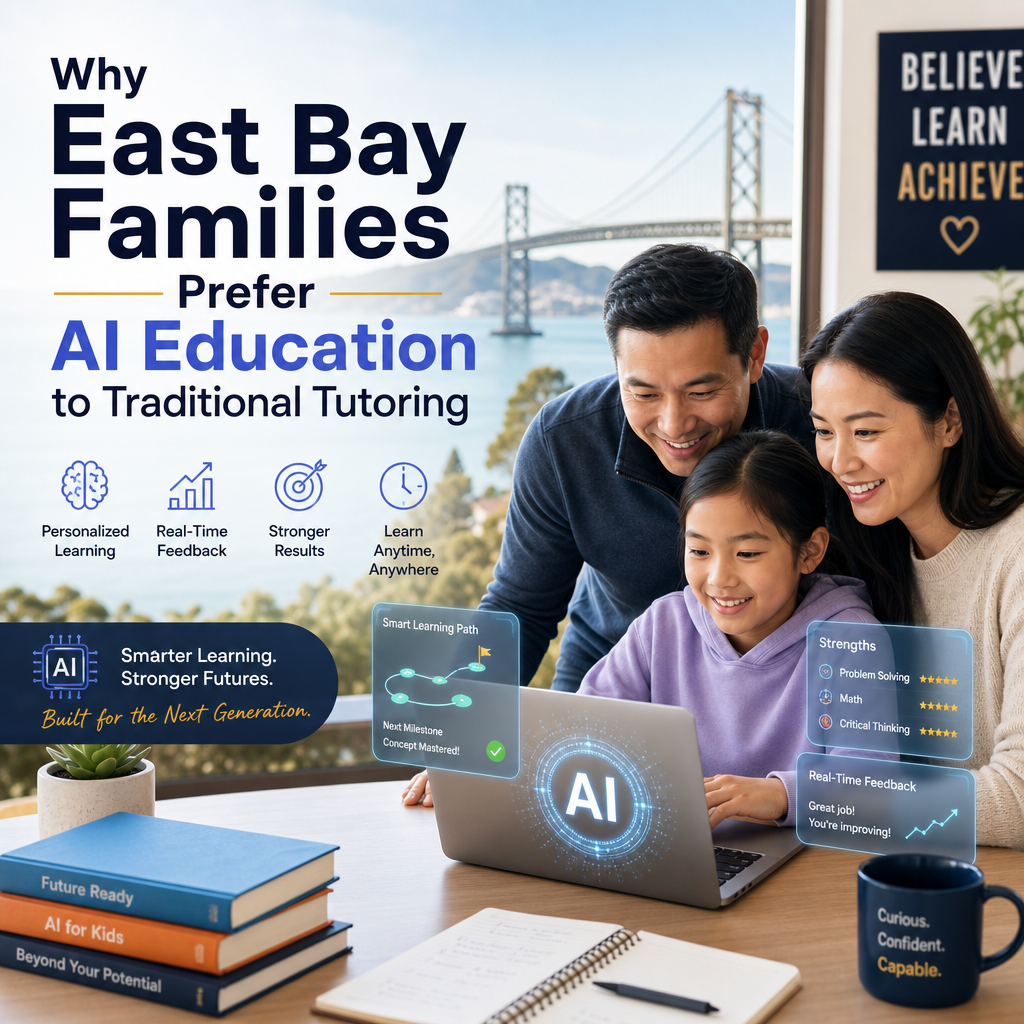
Why East Bay Families Prefer AI Education to Traditional Tutoring
Why East Bay Families Are Choosing AI Education Over Traditional Tutoring
Parents across the East Bay are rethinking what academic support should look like. For years, traditional tutoring was the default solution for students who needed help with math, reading, science, or test prep. But today, many families are turning to AI education as a more flexible, personalized, and practical option.
This shift is not just about technology. It reflects changing family schedules, rising academic expectations, and a growing demand for learning tools that adapt to each student in real time.
The Limits of Traditional Tutoring
Traditional tutoring still works well for some students. A skilled tutor can build confidence, explain concepts clearly, and provide one-on-one encouragement. But for many East Bay families, the model comes with real challenges.
Common frustrations with traditional tutoring
- Limited scheduling options
- High hourly rates
- Commute time across busy neighborhoods
- Inconsistent tutor quality
- One-size-fits-all lesson plans
In a region where parents often balance demanding jobs, school activities, and long commutes, fitting in weekly tutoring sessions can feel like one more logistical burden.
That’s where AI education is changing the picture.
AI Education Offers Learning on Demand
One of the biggest reasons East Bay families are making the switch is convenience. AI-powered learning tools are available whenever students need help, whether that’s after school, in the evening, or during a weekend study session.
Instead of waiting for the next appointment, students can get immediate support. They can ask questions, review missed concepts, and work at their own pace.
This kind of on-demand access is especially valuable for:
- Busy middle and high school students
- Families with multiple children
- Students involved in sports, music, or extracurriculars
- Parents who want support outside standard tutoring hours
For many households, AI education fits into real life more easily than traditional tutoring ever did.
Personalized Support Makes a Big Difference
No two students learn in exactly the same way. Some need extra repetition. Others need faster pacing or different explanations. A traditional tutor may adjust over time, but AI education can respond instantly.
Modern AI learning platforms can analyze performance, identify weak areas, and adapt questions or lessons to match the student’s level. That means students spend less time on material they already understand and more time where they truly need help.
What personalization can look like
- Adjusting difficulty based on student responses
- Providing hints before giving the answer
- Recommending targeted practice in weaker subjects
- Tracking progress over time
- Offering multiple ways to explain the same concept
This personalized approach helps students stay engaged instead of feeling bored, overwhelmed, or left behind.
East Bay Parents Want More Transparency
Another reason families are embracing AI education is visibility. Traditional tutoring sessions can sometimes feel like a black box. A parent may know their child met with a tutor, but not always what was covered, where progress was made, or what still needs work.
AI platforms often include dashboards, progress reports, and skill tracking that make learning more transparent. Parents can see patterns, monitor growth, and make informed decisions about additional support if needed.
For families who value measurable outcomes, this level of insight is a major advantage.
AI Education Can Be More Affordable
Cost matters. In many East Bay communities, private tutoring can become expensive quickly, especially if a student needs ongoing support in multiple subjects.
AI education tools are often more budget-friendly than hiring a tutor several times per week. While some premium platforms require subscriptions, the cost is often far lower than traditional hourly rates.
That affordability opens the door for more consistent practice. Instead of rationing support to one session a week, students can use AI-powered tools regularly and build stronger study habits.
It Supports Independence, Not Just Answers
A common concern is that AI might encourage shortcuts. But when used well, AI education can actually promote independence.
The best platforms do more than give students the answer. They guide problem-solving, ask follow-up questions, and encourage critical thinking. Over time, students learn how to work through challenges on their own.
That matters because the goal is not just better homework completion. It’s building long-term academic confidence.
Skills students can strengthen through AI education
- Self-paced learning
- Time management
- Study consistency
- Problem-solving
- Confidence asking questions
For many East Bay families, that sense of ownership is just as important as grades.
Why This Trend Is Growing in the East Bay
The East Bay has always been a place where education matters. Families here are often proactive, research-driven, and open to solutions that improve outcomes. As schools continue to integrate technology into the classroom, AI education feels like a natural extension of how students already learn.
It also aligns with what many local parents want most: support that is flexible, personalized, and effective without adding more stress to family life.
Traditional tutoring is not disappearing. It still has an important role, especially for students who benefit from face-to-face mentorship. But more families are realizing that AI education can provide daily reinforcement, faster feedback, and a level of personalization that is hard to match.
The Future of Academic Support
The rise of AI education is not about replacing human connection. It’s about giving students smarter tools and giving families more options.
For East Bay families, the appeal is clear: better access, more customization, lower costs, and support that meets students where they are. In a fast-moving academic environment, that kind of help is becoming less of a luxury and more of a necessity.
As education continues to evolve, AI is quickly becoming one of the most practical ways to support student success beyond the classroom.