
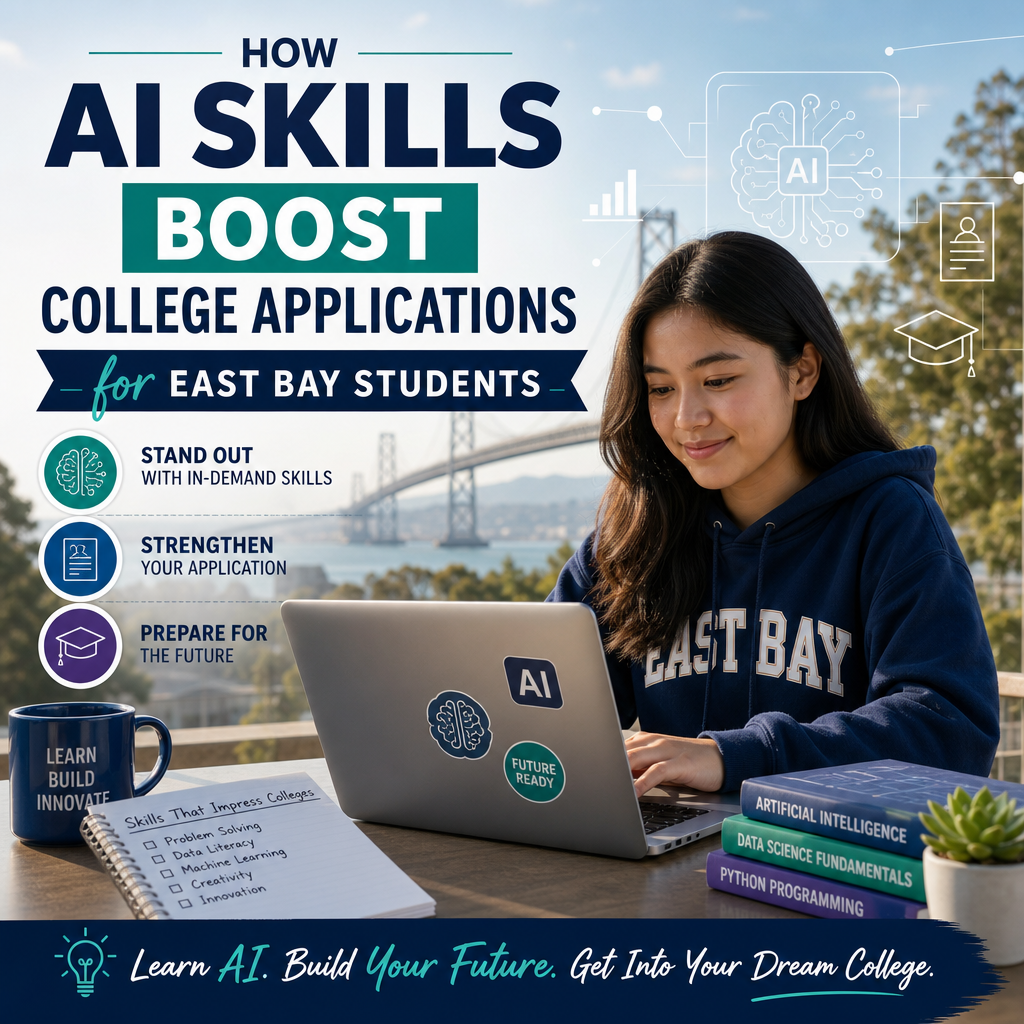
How AI Skills Boost College Applications for East Bay Students
How AI Skills Boost College Applications for East Bay Students
College admissions have become more competitive, especially for students in academically strong communities like the East Bay. Good grades and test scores still matter, but admissions officers are also looking for curiosity, initiative, and real-world problem-solving. That is where AI skills can make a meaningful difference.
For East Bay students, learning artificial intelligence is not just about keeping up with technology trends. It can strengthen college applications by showing that a student is ready to think critically, work across disciplines, and engage with the future in a thoughtful way.
Why Colleges Notice AI Experience
Admissions teams want to see more than a list of classes. They want evidence that a student explores ideas beyond the classroom and applies knowledge in practical ways. AI-related experience often checks several important boxes at once.
Students who build AI skills may demonstrate:
- Intellectual curiosity
- Comfort with challenging material
- Creativity in solving problems
- Initiative through projects or independent learning
- Awareness of how technology affects society
In a college application, these qualities can stand out more than simply saying, “I am interested in STEM.”
How AI Skills Boost College Applications for East Bay Students
East Bay students are in a unique position. The region is close to major technology centers, startup culture, research institutions, and innovation-driven industries. That environment creates opportunities to explore AI in ways that feel relevant and authentic.
When students develop AI skills, they can turn that learning into strong application material through:
Academic Projects
A student might use AI tools to analyze local environmental data, study traffic patterns, or explore public health trends. These projects connect technical skills with real community issues, which makes them compelling in essays and activity lists.
Clubs and Competitions
Participation in robotics teams, coding clubs, hackathons, or data science competitions can show collaboration and persistence. Even smaller school-based projects can help students tell a clear story about growth and leadership.
Research and Independent Learning
Many colleges value self-motivated learners. A student who takes an online AI course, builds a machine learning model, or explores ethics in AI shows initiative. That matters, even if the work happens outside a formal class.
Community Impact
One of the best ways AI skills boost college applications for East Bay students is through service. For example, a student could tutor peers in coding, create a simple chatbot for a school club, or organize a workshop on responsible AI use. Colleges appreciate students who use knowledge to help others.
Stronger Personal Essays and Interviews
AI experience can also lead to better storytelling in college applications. Admissions essays are strongest when they include specific experiences, reflection, and personal growth. AI projects often give students rich material to write about.
A student might discuss:
- How they struggled through a difficult coding problem
- What they learned from building something that failed at first
- Why ethical questions in AI changed the way they think
- How technology can be used to solve local problems in the East Bay
These are not generic experiences. They help a student sound thoughtful, engaged, and memorable.
In interviews, AI-related interests can also spark stronger conversations. Instead of repeating résumé points, students can talk about what they built, what challenged them, and what they hope to explore in college.
AI Shows Readiness for Future Majors and Careers
Not every student who learns AI plans to major in computer science. That is part of what makes it so valuable. AI connects to many fields, including:
- Business
- Biology
- Environmental science
- Psychology
- Economics
- Public policy
- Design
Students can use AI experience to show interdisciplinary thinking. A future biology major might use AI to study genetics data. A student interested in business could explore predictive analytics. A future social science major might examine bias in algorithms.
This flexibility helps students present themselves as adaptable learners, which is attractive to colleges.
What Counts as AI Experience?
Students do not need to publish advanced research or intern at a major tech company. Meaningful experience can start small. Admissions officers often care more about depth and authenticity than prestige.
Examples of useful AI-related activities include:
Beginner-Friendly Options
- Taking a beginner course in Python or machine learning
- Experimenting with AI tools for writing, art, or data analysis
- Building a simple project, such as an image classifier or recommendation tool
- Joining a school coding or robotics club
More Advanced Options
- Conducting independent research with a mentor
- Entering hackathons or STEM competitions
- Creating an app that uses AI features
- Studying AI ethics and presenting findings at school or in the community
The key is reflection. Students should be able to explain what they learned, why it mattered, and how it shaped their goals.
A Smart Advantage for East Bay Applicants
How AI skills boost college applications for East Bay students comes down to more than technical ability. AI learning can help students build a strong profile that combines academics, creativity, leadership, and real-world awareness.
In a region known for innovation, students who engage with AI thoughtfully can show colleges that they are not just prepared for the future—they are already participating in it.
For East Bay students applying to college, AI skills can become more than an extracurricular interest. They can become a clear signal of initiative, relevance, and readiness for what comes next.