
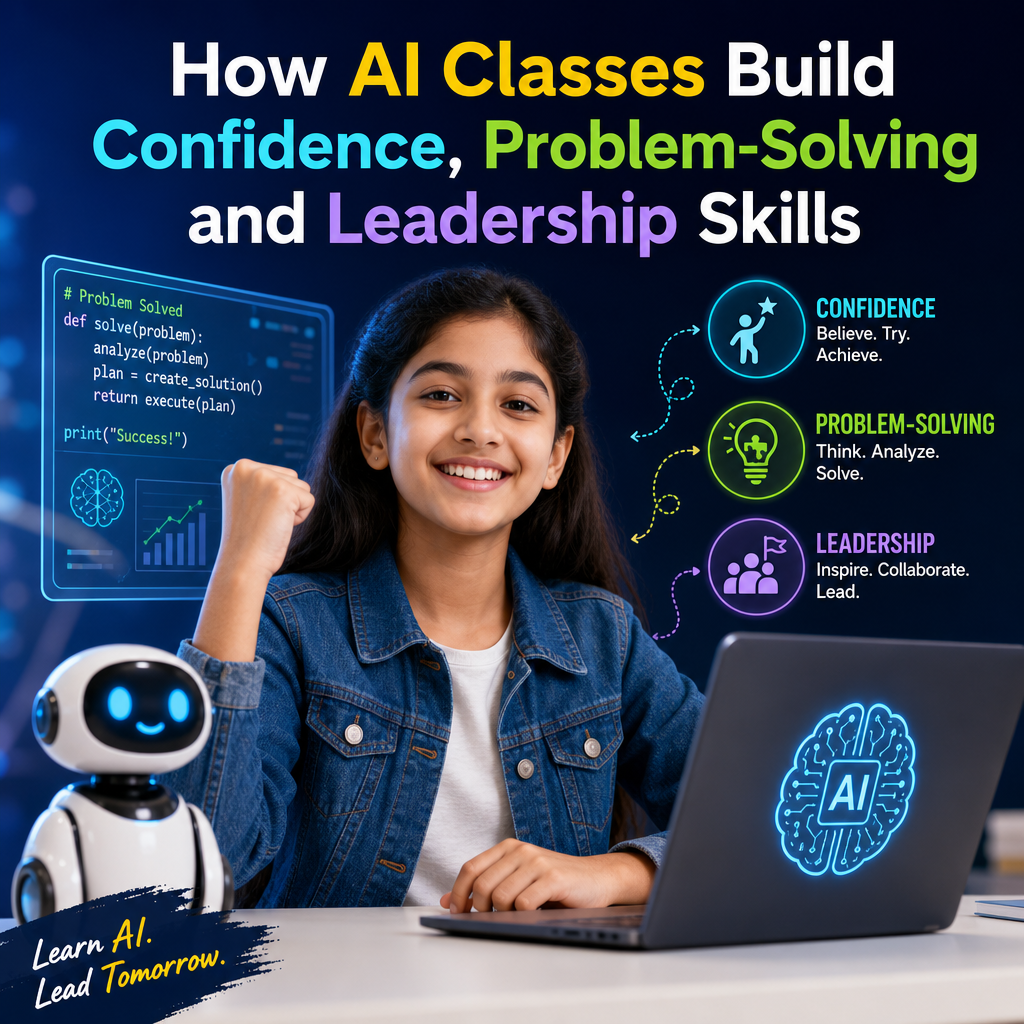
How AI Classes Build Confidence, Problem-Solving and Leadership Skills
How AI Classes Build Confidence, Problem-Solving & Leadership Skills
Artificial intelligence is often discussed as a technical subject, but its value goes far beyond coding and algorithms. In reality, AI classes can help students develop some of the most important life and career skills: confidence, problem-solving, and leadership.
As AI becomes part of daily life, learning how it works gives students more than digital knowledge. It gives them the ability to think clearly, communicate ideas, and take initiative in a fast-changing world.
Why AI Classes Matter Beyond Technology
Many people assume AI education is only for future programmers or engineers. But the classroom experience is much broader than that.
In well-designed AI classes, students are encouraged to:
- Ask questions and explore ideas
- Test solutions through trial and error
- Work with others on projects
- Present their thinking with clarity
- Reflect on both success and failure
These experiences naturally build personal growth. Students do not just learn what AI can do. They learn what they can do.
Building Confidence Through Hands-On Learning
Confidence grows when students feel capable. AI classes support that growth by turning abstract ideas into practical challenges students can solve.
Learning by Doing
Instead of passively memorizing facts, students often create something tangible in AI classes. They might train a simple model, design a chatbot, or analyze patterns in data.
When students see their work produce real results, they begin to trust their own ability to learn and adapt. Even small wins can have a powerful effect.
Making Mistakes Without Fear
AI projects rarely work perfectly on the first try. That is actually one of their biggest strengths as a learning tool.
Students quickly discover that mistakes are not signs of failure. They are part of the process. Debugging, adjusting inputs, and trying again teaches resilience. Over time, this reduces fear and helps students become more confident in unfamiliar situations.
Finding a Voice
Many AI classes include discussions about ethics, fairness, privacy, and the impact of technology on society. These conversations give students a chance to share opinions and defend their ideas.
This helps quieter learners speak up and encourages all students to develop a stronger sense of voice and perspective.
Strengthening Problem-Solving Skills
At its core, AI education is about solving problems. Students are asked to think logically, break down complex tasks, and improve outcomes step by step.
Breaking Big Problems Into Smaller Steps
One of the most valuable lessons in AI classes is how to approach complexity.
Students learn to:
- Define the problem clearly
- Identify what information is needed
- Test possible solutions
- Evaluate what worked and what did not
- Improve the result through iteration
This process is useful far beyond technology. It helps students become more organized, analytical, and creative in any subject or real-world challenge.
Encouraging Curiosity and Critical Thinking
AI classes also push students to think deeper. Why did a model make a certain prediction? What data is missing? Is the result fair or biased?
These questions sharpen critical thinking. Students learn not to accept outcomes at face value. Instead, they investigate, question assumptions, and seek better answers.
That kind of thinking is essential in school, at work, and in leadership roles.
How AI Classes Develop Leadership Skills
Leadership is not only about giving instructions. It is about initiative, communication, collaboration, and responsibility. AI classes create many opportunities for students to practice these skills.
Collaboration on Projects
AI projects are often completed in teams. Students may divide tasks, combine ideas, and solve challenges together.
In group settings, leadership naturally emerges when students:
- Organize the workflow
- Support teammates
- Share knowledge
- Keep the group focused
- Help resolve disagreements
These experiences teach students how to lead by contributing, listening, and guiding others toward a shared goal.
Presenting Ideas With Clarity
Many AI classes ask students to explain what they built and why it matters. Presenting a project helps students organize their thoughts and communicate with confidence.
This is an important leadership skill. Whether speaking in a classroom, meeting, or community setting, the ability to explain complex ideas clearly can set students apart.
Understanding Responsibility
AI education also introduces an important leadership lesson: technology affects people. Students explore how AI decisions can shape opportunities, access, and outcomes.
When students consider questions of ethics and responsibility, they begin to think like thoughtful leaders. They learn that good leadership is not just about innovation. It is also about making fair, informed, and responsible choices.
Real-World Benefits That Last
The skills developed in AI classes are highly transferable. A student who learns to present an AI project can also speak more confidently in other subjects. A student who learns to troubleshoot a model can apply the same process to science experiments, business ideas, or personal challenges.
These long-term benefits include:
- Greater self-belief
- Stronger communication skills
- Better teamwork
- Improved decision-making
- More comfort with change and uncertainty
In a world where technology is constantly evolving, these human skills may be the most valuable outcome of all.
Final Thoughts
AI classes are not just preparing students for future jobs in tech. They are preparing them to become capable, thoughtful, and confident individuals.
By encouraging experimentation, teamwork, critical thinking, and responsibility, AI classes help students grow in ways that extend far beyond the classroom. They build the confidence to try, the problem-solving skills to adapt, and the leadership ability to make a meaningful impact.
That is what makes AI education so powerful. It teaches students not only how to work with technology, but how to lead with it.