

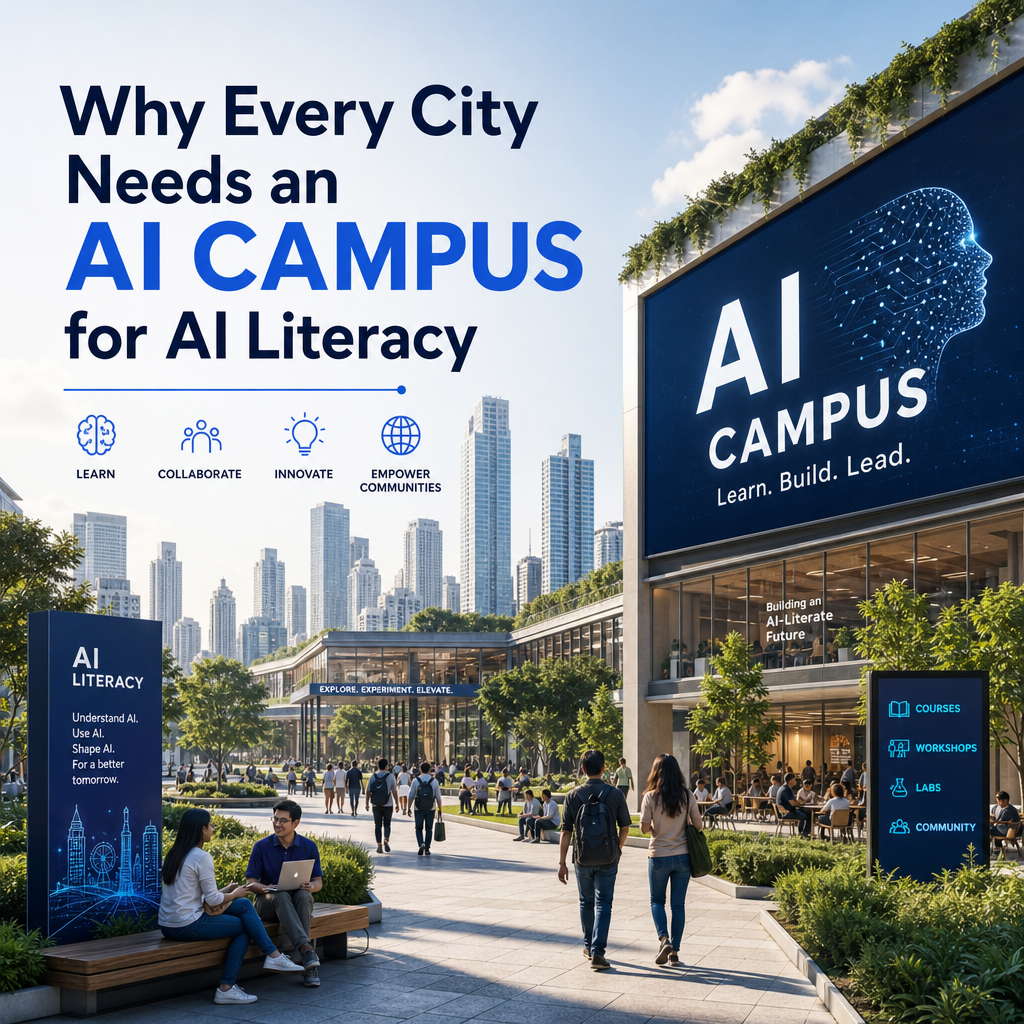
Why Every City Needs an AI Campus for AI Literacy
The National Impact of AI Literacy: Why Every City Needs an AI Campus
Artificial intelligence is no longer a niche topic for engineers and tech companies. It is becoming part of daily life, from healthcare and education to logistics, public services, and small business operations. As AI spreads across every sector, one truth is becoming impossible to ignore: AI literacy is now a public necessity.
That is why the idea of an AI campus matters so much. More than a training center or innovation hub, an AI campus can become a local engine for education, workforce development, entrepreneurship, and civic readiness. If every city had one, the national impact would be profound.
AI Literacy Is the New Economic Foundation
In previous generations, economic mobility depended on access to basic education, then digital skills, and later internet connectivity. Today, the next step is clear: communities need widespread understanding of how AI works, where it is used, and how to apply it responsibly.
AI literacy does not mean everyone must become a machine learning engineer. It means people should know enough to:
- use AI tools effectively at work
- understand the risks of bias, privacy, and misinformation
- make informed decisions as consumers and citizens
- adapt to changing job requirements
Without this knowledge, cities risk falling behind. Workers may be displaced without pathways to reskilling. Small businesses may struggle to compete. Local governments may adopt AI tools without enough public understanding or oversight.
An AI campus helps close that gap by making AI education accessible, practical, and community-based.
Why Every City Needs an AI Campus
A strong local AI campus can create benefits that go far beyond a single school or tech center. It can serve as a shared resource for students, job seekers, employers, public officials, and entrepreneurs.
1. It builds a future-ready workforce
Cities need workers who can do more than operate traditional software. Across industries, employers are looking for people who can collaborate with AI systems, automate repetitive tasks, analyze data, and evaluate AI-generated outputs.
An AI campus can offer:
- short-form certification programs
- career transition training
- hands-on workshops for non-technical professionals
- partnerships with local employers
This kind of training creates a talent pipeline that stays local. Instead of watching opportunity migrate to large tech centers, cities can develop their own skilled workforce.
2. It supports small business growth
Large corporations can afford consultants, AI tools, and internal innovation teams. Small businesses often cannot. That creates a widening gap in productivity and competitiveness.
An AI campus can help local business owners learn how to use AI for:
- customer support
- marketing content
- inventory management
- scheduling and operations
- data-driven decision-making
When local businesses become more efficient, the whole regional economy benefits.
3. It improves civic resilience
AI is increasingly used in public systems, including transportation, emergency response, hiring, education, and health administration. Communities need places where these changes can be discussed openly and understood clearly.
An AI campus can host public seminars, ethics forums, and policy discussions that help residents engage with AI as informed participants rather than passive observers. That matters for trust, transparency, and long-term democratic accountability.
The National Impact Starts at the Local Level
National competitiveness is often discussed in terms of federal policy, major research labs, and global technology races. Those things matter, but they are only part of the story.
A country becomes truly AI-capable when ordinary communities can participate in the transformation. That means national progress depends on local access.
If every city developed an AI campus, the broader impact could include:
Expanded economic opportunity
AI literacy would no longer be concentrated in a few elite urban centers. More people, from more backgrounds, could access high-value careers and business opportunities.
Reduced regional inequality
Many smaller cities and underserved communities are at risk of being left out of the AI economy. Local AI campuses would help distribute knowledge, infrastructure, and opportunity more evenly.
Stronger innovation ecosystems
Innovation does not only happen in Silicon Valley-style environments. It grows where educators, startups, employers, and public institutions collaborate. An AI campus creates a physical and cultural center for that collaboration.
Better public understanding of AI
When people understand AI, they are less vulnerable to fear, hype, and misinformation. A more AI-literate public is better equipped to ask hard questions and support responsible adoption.
What an AI Campus Should Include
Not every city will build the same model, and that is a good thing. Local needs should shape local design. Still, the most effective AI campus initiatives will likely share a few core elements:
Education for all levels
Programs should serve high school students, college learners, mid-career workers, executives, and retirees. AI literacy must be broad, not exclusive.
Practical, job-connected training
Theory matters, but practical use matters more. Cities need training tied to real tools, real workflows, and real employer demand.
Public-private partnerships
Colleges, businesses, libraries, nonprofits, and local governments should all have a role. An AI campus works best as a civic ecosystem, not an isolated institution.
Ethics and responsible use
AI literacy should include privacy, fairness, accountability, and human oversight. Cities need people who can use AI well and question it wisely.
A National Strategy Hidden in Plain Sight
The conversation about AI often feels abstract, global, and dominated by giant institutions. But one of the most effective national strategies may be surprisingly local: give every city a place to learn, build, and think critically about AI.
An AI campus is not just a symbol of innovation. It is a practical investment in people. It helps workers stay relevant, businesses stay competitive, students stay curious, and communities stay informed.
If the future will be shaped by AI, then every city deserves the tools to shape that future too.