

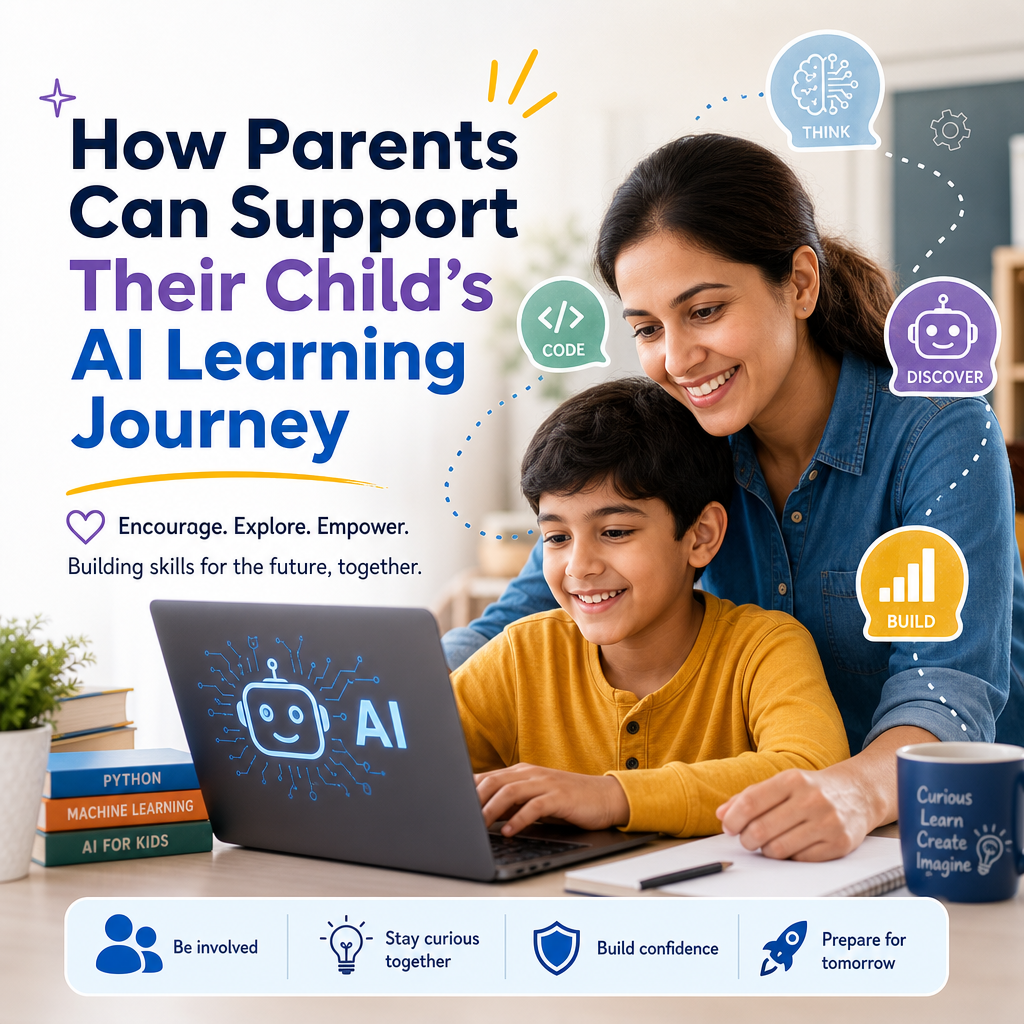
How Parents Can Support Their Child’s AI Learning Journey
How Parents Can Support Their Child’s AI Learning Journey
Artificial intelligence is becoming part of everyday life, from search tools and smart assistants to apps used in school and work. That is why many families are thinking about how to support a child’s AI learning journey in a healthy, practical way.
The good news is that parents do not need to be tech experts to help. What matters most is curiosity, guidance, and a willingness to learn alongside your child.
Why AI Learning Matters for Kids
AI is not just about coding or robots. It also teaches children how technology works, how decisions can be influenced by data, and why critical thinking matters online.
When kids begin to understand AI, they can:
- Use digital tools more thoughtfully
- Ask better questions about the information they see
- Build problem-solving and creative thinking skills
- Prepare for a future where AI will be common in many careers
An AI learning journey can start small. A child might explore how a chatbot answers questions, how image tools work, or how recommendations appear on streaming platforms. These simple moments can lead to deeper discussions.
Start With Curiosity, Not Pressure
One of the best ways parents can help is by keeping the experience relaxed and age-appropriate. Children learn best when they feel interested, not pushed.
Instead of turning AI into a heavy academic topic, start with everyday questions such as:
- How does a voice assistant understand what we say?
- Why do video apps suggest certain content?
- Can computers really “think,” or do they follow patterns?
These conversations make AI feel accessible. They also show children that learning is not about having all the answers right away.
Learn Together as a Family
You do not need to lead every lesson. In many cases, the strongest support comes from learning beside your child.
Explore Simple Tools
Try beginner-friendly AI tools designed for education or creativity. For example, you can:
- Ask a chatbot to explain a science topic
- Use an image generator to discuss prompts and results
- Compare how different tools answer the same question
- Explore coding platforms that introduce machine learning basics
The goal is not to master everything. It is to build confidence and encourage questions.
Model a Healthy Learning Attitude
Children notice how adults respond to new technology. If you approach AI with openness and care, they are more likely to do the same.
Say things like:
- “Let’s figure this out together.”
- “That answer sounds interesting, but let’s check if it’s accurate.”
- “What do you think this tool is doing behind the scenes?”
This helps children see AI as something to understand, not just something to trust.
Teach Critical Thinking Early
A child’s AI learning journey should include more than using tools. It should also include learning when to question them.
AI can produce helpful results, but it can also make mistakes, reflect bias, or present false information confidently. Parents can help children build healthy digital habits by teaching them to pause and think.
Key Questions Kids Can Ask
Encourage your child to ask:
- Is this information correct?
- Where might this answer have come from?
- Does this response seem fair or one-sided?
- Should I check another source?
These habits are valuable not only for AI use, but for digital literacy in general.
Set Boundaries Around Safe and Responsible Use
Support also means creating clear expectations. Children should understand that AI tools are useful, but they should be used responsibly.
Here are a few simple family rules to consider:
- Do not share personal or private information with AI tools
- Use AI to support learning, not replace original thinking
- Double-check important facts with trusted sources
- Talk to a parent or teacher if a result feels confusing or inappropriate
Boundaries help children use technology with confidence and care.
Encourage Creativity, Not Just Consumption
AI can be a powerful creative partner when used well. Instead of only consuming content, children can use AI to make things, test ideas, and express themselves.
For example, they might:
- Brainstorm story ideas
- Create art prompts
- Build simple projects
- Practice foreign language conversations
- Generate questions for a school topic they want to explore
When parents encourage creativity, the AI learning journey becomes active and engaging rather than passive.
Connect AI to Real Life
Children often learn best when a topic feels relevant to their own world. Try connecting AI to things they already enjoy, such as sports, music, games, art, or animals.
You might ask:
- How do music apps recommend songs?
- How do games adjust to player behavior?
- How might AI help doctors, farmers, or teachers?
These examples show that AI is not a distant concept. It is already shaping many parts of life.
Celebrate Progress Over Perfection
Every child will move at a different pace. Some may love experimenting with tools right away, while others may be more cautious. Both approaches are fine.
What matters is creating a supportive environment where children feel safe to ask questions, test ideas, and make mistakes. A positive AI learning journey is built through regular conversations, small discoveries, and shared curiosity.
Final Thoughts
Parents play an important role in helping children understand the technology around them. You do not need advanced technical knowledge to make a difference. By staying curious, encouraging critical thinking, setting healthy boundaries, and exploring tools together, you can support your child’s AI learning journey in a meaningful way.
In the end, the goal is not just to raise children who know how to use AI. It is to help raise children who know how to use it wisely.