

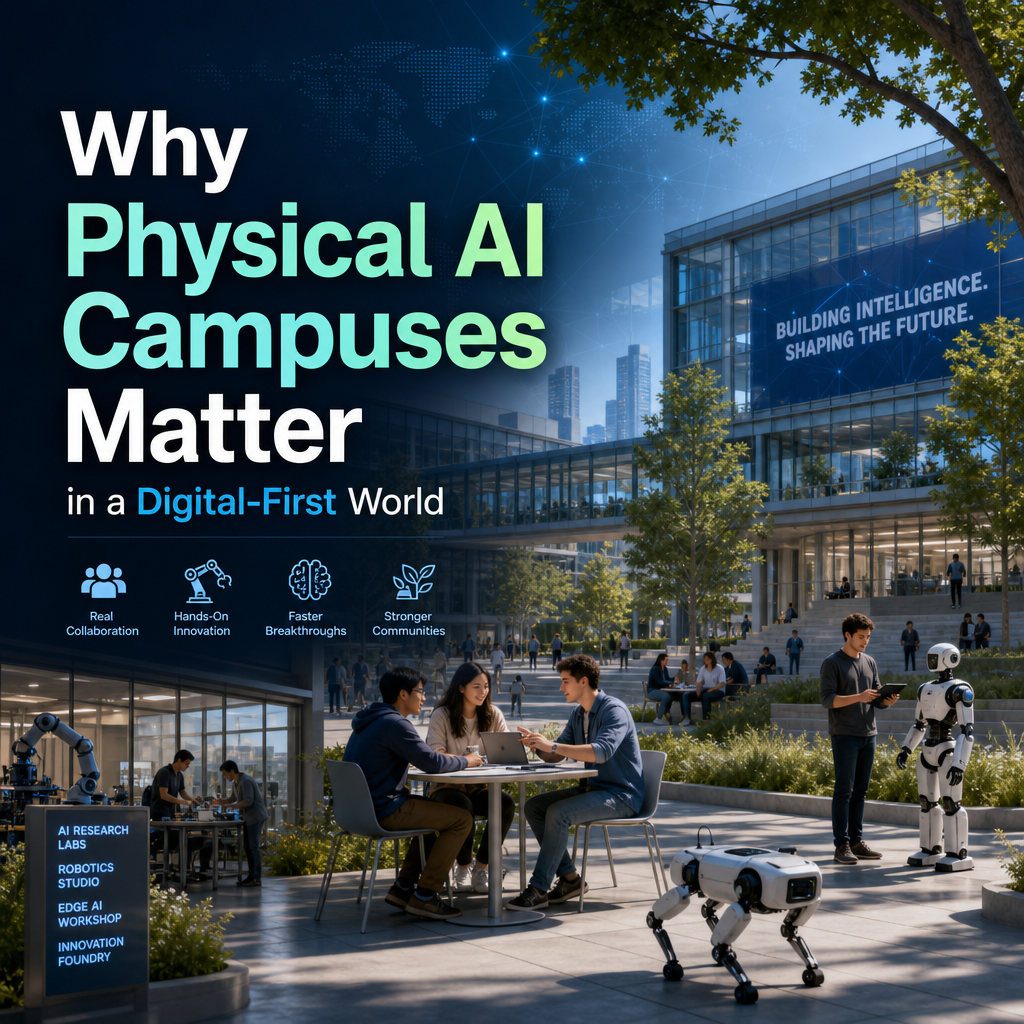
Why Physical AI Campuses Matter in a Digital-First World
The Case for Physical AI Campuses
In a world shaped by cloud platforms, remote teams, and always-on digital tools, it can seem counterintuitive to invest in bricks, power lines, and physical infrastructure. Yet that is exactly why physical AI campuses matter in a digital-first world.
Artificial intelligence may feel weightless when people interact with chatbots, image generators, or analytics dashboards. But behind every AI tool is a very physical system: servers, chips, cooling equipment, fiber connections, backup power, and the people who maintain them. As AI adoption accelerates, the need for purpose-built, physical spaces is becoming impossible to ignore.
AI Is Digital on the Surface, Physical at the Core
Most users experience AI through apps and interfaces. What they do not see is the enormous hardware footprint required to train, deploy, and scale modern models.
A single advanced AI workload depends on:
- High-density compute clusters
- Reliable, low-latency networking
- Massive power availability
- Sophisticated cooling systems
- Physical security and operational support
These are not abstract needs. They require real land, real facilities, and real engineering. Physical AI campuses bring all of these elements together in one designed environment, making large-scale AI practical rather than theoretical.
Why Traditional Data Center Models Are Not Always Enough
Conventional data centers were built for storage, enterprise applications, and general cloud services. AI changes the equation.
Training and running large AI models often demand:
More Power
AI infrastructure consumes far more electricity than many traditional workloads. A campus built specifically for AI can be designed with energy capacity in mind from day one, rather than retrofitting older facilities.
More Cooling
High-performance GPUs and accelerators generate serious heat. Without advanced cooling, performance suffers and equipment lifespan can shrink. Physical AI campuses can integrate liquid cooling, airflow optimization, and thermal management at scale.
More Space for Growth
AI demand is not standing still. Organizations need room to expand compute clusters, storage, and networking as model sizes and usage grow. Campus-style development supports phased expansion better than scattered facilities.
The Value of Concentration and Proximity
One of the strongest arguments for physical AI campuses is concentration. Instead of spreading infrastructure across disconnected locations, campuses create environments where compute, networking, talent, and support systems operate close together.
That concentration creates several advantages:
- Faster deployment of new AI capacity
- Better coordination between infrastructure and operations teams
- Greater resilience through integrated design
- Easier maintenance and upgrades
- Stronger ecosystems around research and development
In other words, physical proximity can improve digital performance. That is a powerful reminder that the digital world still depends on real-world logistics.
Physical Campuses Help Build AI Ecosystems, Not Just Infrastructure
The phrase “AI campus” should not be limited to rows of servers. The most valuable campuses can become hubs where infrastructure, talent, education, and innovation intersect.
A strong physical AI campus can support:
Research and Industry Collaboration
When companies, universities, startups, and technical teams operate near one another, collaboration becomes easier. Ideas move faster when the right people can meet, test, and iterate in the same environment.
Workforce Development
AI growth requires more than software engineers. It also depends on electricians, facilities operators, network specialists, cooling experts, and security teams. Physical campuses create opportunities for broader workforce training and regional job creation.
Long-Term Regional Investment
Unlike purely virtual platforms, campuses anchor investment in a place. They can drive improvements in energy infrastructure, connectivity, transportation, and local business ecosystems.
Trust, Security, and Sovereignty Matter More Than Ever
As AI becomes central to healthcare, finance, government, and critical industry, questions of control and trust are becoming more important.
Organizations increasingly want to know:
- Where their AI workloads are running
- Who controls the infrastructure
- How data is secured physically and digitally
- Whether capacity is reliable during periods of high demand
Physical AI campuses can help answer those questions. Purpose-built facilities offer tighter operational oversight, stronger security design, and clearer governance than loosely distributed systems. For many sectors, that level of control is not just helpful—it is essential.
Digital-First Does Not Mean Physical-Free
A digital-first strategy is often misunderstood as a purely online strategy. In reality, digital-first means prioritizing digital experiences and capabilities. It does not eliminate the need for physical foundations.
Think of it this way: the more digital the economy becomes, the more important underlying infrastructure becomes. AI is pushing that reality into the spotlight.
Physical AI campuses matter because they provide the foundation for:
- Scalable AI services
- Faster innovation cycles
- Better reliability and performance
- Stronger regional technology ecosystems
- Greater control over critical infrastructure
Without that foundation, digital ambition can quickly run into physical limits.
The Future of AI Will Be Built in Real Places
The next era of AI will not be powered by software alone. It will be built on electricity, cooling, networking, land, and human expertise—all organized in ways that support massive computational demand.
That is why physical AI campuses matter in a digital-first world. They turn abstract AI potential into operational reality. They make growth sustainable, innovation faster, and infrastructure more resilient.
As businesses and governments plan for the next wave of AI adoption, the key question is not whether physical infrastructure still matters. It is whether they are building enough of the right kind, in the right places, to support what comes next.